
<?xml version="1.0" encoding="UTF-8"?><rss xmlns:itunes="http://www.itunes.com/dtds/podcast-1.0.dtd" version="2.0"><channel><title>BirdNote Podcast RSS Feed</title><link>http://www.birdnote.org/birdnotepodcast.cfm</link><description>BirdNote Podcast RSS Feed</description><language>en-us</language><itunes:image href="http://www.birdnote.org/img/podcast_image.jpg"/><image><link>http://www.birdnote.org/birdnotepodcast.cfm</link><title>BirdNote Podcast RSS Feed</title><url>http://www.birdnote.org/img/podcast_image.jpg</url></image><itunes:author>Tune In to Nature.org</itunes:author><itunes:explicit>no</itunes:explicit><itunes:category text="Science &amp; Medicine"><itunes:category text="Natural Sciences"/></itunes:category><itunes:owner><itunes:name>Tune In to Nature.org</itunes:name><itunes:email>info@birdnote.org</itunes:email></itunes:owner><item><title>Montezuma Oropendola's High-Security Nesting</title><link>http://www.birdnote.org/birdnote.cfm?id=1050</link><description>A male Montezuma Oropendola holds forth in a tree bedecked with twenty or more&#160; hanging nests. The nests are intricately woven sacks hanging three feet or more from the branches. Oropendolas favor trees that are separate from other trees and often build near large nests of wasps, whose stinging attacks deter both potential nest predators and parasitic insects.&#160;Learn more.
</description><itunes:author>Tune In to Nature.org</itunes:author><itunes:explicit>no</itunes:explicit><pubDate>Thu, 11 Mar 2010 00:02:00 PST</pubDate><enclosure url="http://birdnote.s3.amazonaws.com/Birdnote/2007/Mar_2007/100311-Montezuma-Oropendolas-High-Security-Nests.mp3" length="1592380" type="audio/mpeg" /></item><item><title>The Golden Pendulum - Montezuma Oropendola</title><link>http://www.birdnote.org/birdnote.cfm?id=1049</link><description>In a clearing where an ancient Mayan city once stood, the Montezuma Oropendola perches and sings. His courtship display is astonishing: he swings by his feet and sings, his tail describing a golden pendulum &#8211; the very source of his name in Spanish &#8211; oropendola.
Learn more about the Montezuma Oropendola at&#160;RainForest.org.
</description><itunes:author>Tune In to Nature.org</itunes:author><itunes:explicit>no</itunes:explicit><pubDate>Wed, 10 Mar 2010 00:02:00 PST</pubDate><enclosure url="http://birdnote.s3.amazonaws.com/Birdnote/2007/Mar_2007/100310-The-Golden-Pendulum-Montezuma-Oropendola.mp3" length="1570881" type="audio/mpeg" /></item><item><title>Robins and Berries in Winter</title><link>http://www.birdnote.org/birdnote.cfm?id=1443</link><description>It&#8217;s mid-winter, and a passing flock of robins suddenly drops out of the sky. A moment ago, the yard was empty of birds, but now it&#8217;s full. They settle in a bush laden with fruits. When the robins pass over a fruiting shrub, those red berries signal like a neon sign on a restaurant. Time to stop for a meal!&#160;Learn more about the American Robin Cornell's&#160;AllAboutBirds.
Learn more about gardening for life&#160;&#8212; and for wildlife&#160;&#8212; at&#160;AudubonAtHome.org.
</description><itunes:author>Tune In to Nature.org</itunes:author><itunes:explicit>no</itunes:explicit><pubDate>Tue, 09 Mar 2010 00:02:00 PST</pubDate><enclosure url="http://birdnote.s3.amazonaws.com/Birdnote/2008/Mar_2008/100309-Robins-and-Berries-in-Winter.mp3" length="1595006" type="audio/mpeg" /></item><item><title>A Treasure Chest</title><link>http://www.birdnote.org/birdnote.cfm?id=621</link><description>Hummingbirds&#8217; names evoke their exquisite qualities and variety, from sabrewings to woodstars to sunangels&#8212;to this Green Violet-ear.&#160;Central and South America are home to well over 300 species of hummingbirds! Find out more about hummingbird migration -- and what hummingbirds might be coming your way --&#160;at&#160;HummingbirdWorld.&#160;Learn how to attract hummingbirds to your yard at&#160;Hummingbirds.net.
Browse this lovely&#160;gallery of photos&#160;by William Zittrich and Jon Gallagher.
</description><itunes:author>Tune In to Nature.org</itunes:author><itunes:explicit>no</itunes:explicit><pubDate>Mon, 08 Mar 2010 00:02:00 PST</pubDate><enclosure url="http://birdnote.s3.amazonaws.com/Birdnote/2006/March_06/100308-A-Treasure-Chest-of-Hummingbirds.mp3" length="1607286" type="audio/mpeg" /></item><item><title>Flicker Attack</title><link>http://www.birdnote.org/birdnote.cfm?id=1719</link><description>In early spring, a male flicker may drum on a metal stovepipe or other resonant surface to attract a mate and proclaim his territory. This doesn&#8217;t damage your house. If your flicker is drilling for food, you&#8217;d better check for carpenter ants or other insects! A flicker may also be excavating a nest cavity. If so, you can put up a nestbox nearby. The pair that adopts it will keep other flickers away. If it&#8217;s late spring or summer and you discover a big hole, there&#8217;s probably a brood inside, and it&#8217;s illegal to disturb them. Find out how to&#160;live with flickers, without conflicts.
</description><itunes:author>Tune In to Nature.org</itunes:author><itunes:explicit>no</itunes:explicit><pubDate>Sun, 07 Mar 2010 00:02:00 PST</pubDate><enclosure url="http://birdnote.s3.amazonaws.com/Birdnote/2010/03-Mar-2010/100307-Flicker-Attack.mp3" length="1586838" type="audio/mpeg" /></item><item><title>Rufous Hummingbirds Are on the Way</title><link>http://www.birdnote.org/birdnote.cfm?id=1046</link><description>It&#8217;s March, and - following a winter sojourn in Mexico - thousands of fiery-orange male&#160;Rufous Hummingbirds&#160;are migrating northward, ahead of the females. Many pass through California on their way to breeding sites in the Northwest. To learn more about how to attract Rufous Hummingbirds to your yard, visit&#160;Hummingbirds.net.
Get&#160;the BirdNote&#160;podcast&#160;and listen any time you wish!
</description><itunes:author>Tune In to Nature.org</itunes:author><itunes:explicit>no</itunes:explicit><pubDate>Sat, 06 Mar 2010 00:02:00 PST</pubDate><enclosure url="http://birdnote.s3.amazonaws.com/Birdnote/2007/Mar_2007/100306-Rufous-Hummingbirds-Are-on-their-Way.mp3" length="1567439" type="audio/mpeg" /></item><item><title>Red-tailed Hawk, Bulky Bird</title><link>http://www.birdnote.org/birdnote.cfm?id=58</link><description>The&#160;Red-tailed Hawk&#160;is the most common and widespread hawk in North America. Red-tails often perch on fence posts in rural areas or even atop lights along the roadway. Watch for a large, bulky,&#160;football-shaped bird with a small dark head and a rusty-red tail. These hawks visit open fields to feast on the abundant populations of rodents and wintering shorebirds.
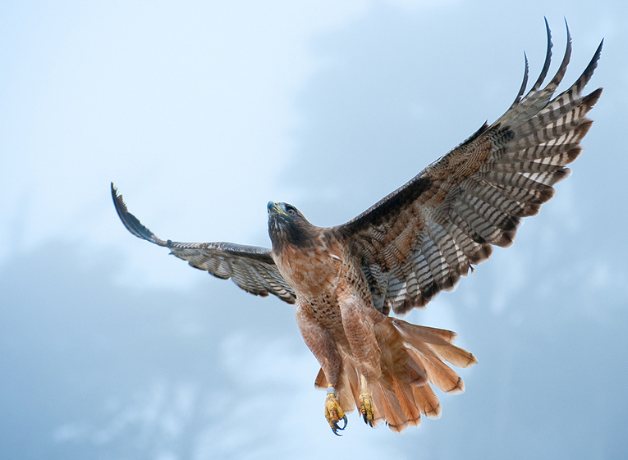
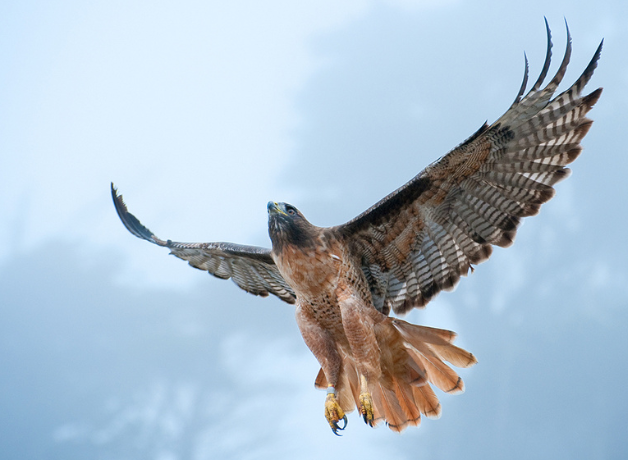
KPLU Listeners, you can attend a field trip to see hawks and more on Sunday, March 7.&#160;Learn more.
If you'd like to make a gift to BirdNote,&#160;begin here.
</description><itunes:author>Tune In to Nature.org</itunes:author><itunes:explicit>no</itunes:explicit><pubDate>Fri, 05 Mar 2010 00:02:00 PST</pubDate><enclosure url="http://birdnote.s3.amazonaws.com/Birdnote/2005/March/100305-Red-tailed-Hawk-Bulky-Bird.mp3" length="1620039" type="audio/mpeg" /></item><item><title>The Myth of the Kiwi</title><link>http://www.birdnote.org/birdnote.cfm?id=1048</link><description>&#8220;Why the Kiwi Lost its Wings&#8221; is a myth from the Maori people of New Zealand. Kiwi loved the forest so much that he forsook his wings and beautiful feathers to dwell on the ground and devour the enemies of the forest. The Kiwi is the national symbol of New Zealand, as depicted on this postage stamp. The New Zealand dollar&#160;is even nicknamed "the Kiwi."
Learn about the Brown Kiwi and more at&#160;SaveTheKiwi.
</description><itunes:author>Tune In to Nature.org</itunes:author><itunes:explicit>no</itunes:explicit><pubDate>Thu, 04 Mar 2010 00:02:00 PST</pubDate><enclosure url="http://birdnote.s3.amazonaws.com/Birdnote/2007/Mar_2007/100304-The-Myth-of-the-Kiwi.mp3" length="1610525" type="audio/mpeg" /></item><item><title>Brown Kiwi</title><link>http://www.birdnote.org/birdnote.cfm?id=1047</link><description>Kiwis are so unlike other birds that they&#8217;ve been called &#8220;honorary mammals.&#8221; Kiwis cannot fly, having evolved in New Zealand&#8217;s island environment without mammalian predators. The only bird to have nostrils at the end of its beak, the kiwi snuffles and snorts as it probes the forest floor for worms and insects.&#160;Learn more. Find out about Kiwi conservation at&#160;SaveTheKiwi.
If you'd like to make a gift to BirdNote,&#160;begin here.
</description><itunes:author>Tune In to Nature.org</itunes:author><itunes:explicit>no</itunes:explicit><pubDate>Wed, 03 Mar 2010 00:02:00 PST</pubDate><enclosure url="http://birdnote.s3.amazonaws.com/Birdnote/2007/Mar_2007/100303-Brown-Kiwi.mp3" length="1654956" type="audio/mpeg" /></item><item><title>Eagles Rebuild</title><link>http://www.birdnote.org/birdnote.cfm?id=620</link><description>Bald Eagles build large stick nests in tall trees. These nests endure rough treatment. Rambunctious chicks pull sticks out and flap madly, holding on with their feet, before they fledge. Wind buffets the nest year round. But eagles reuse their nests&#160;year after year.&#160;Adult eagles break off dead limbs and carry them back to their nests. Bald Eagles have been known to carry sticks more than a mile to their nest.
Get BirdNote as a podcast! Sign up&#160;here.
</description><itunes:author>Tune In to Nature.org</itunes:author><itunes:explicit>no</itunes:explicit><pubDate>Tue, 02 Mar 2010 00:02:00 PST</pubDate><enclosure url="http://birdnote.s3.amazonaws.com/Birdnote/2006/March_06/100302-Eagles-Rebuild.mp3" length="1641316" type="audio/mpeg" /></item><item><title>Kinglets in Winter</title><link>http://www.birdnote.org/birdnote.cfm?id=1043</link><description>The&#160;Golden-crowned Kinglet&#160;weighs six grams, the weight of two pennies, yet it survives under conditions that would make a grizzly bear shiver. Wintering as far north as Alaska and Nova Scotia, with short days, intense cold, and heavy snow, how can kinglets possibly stay alive? Good insulation and lots of food! Read about&#160;Bernd Heinrich&#8217;s research.
Drop us a line and let us know what you think of BirdNote: info@birdnote.org.
</description><itunes:author>Tune In to Nature.org</itunes:author><itunes:explicit>no</itunes:explicit><pubDate>Mon, 01 Mar 2010 00:02:00 PST</pubDate><enclosure url="http://birdnote.s3.amazonaws.com/Birdnote/2007/Mar_2007/100301-Kinglets-in-Winter.mp3" length="1582379" type="audio/mpeg" /></item><item><title>Birds in Music</title><link>http://www.birdnote.org/birdnote.cfm?id=1427</link><description>We have many examples of music inspired by birdsong, but there are also composers who have used actual bird sounds in their works, including Ottorino Respighi in his 1923 work, The Pines of Rome. When Finnish composer Einojuhani Rautavaara composed "Cantus Arcticus" (also known as &#8220;Concerto for Birds and Orchestra&#8221;), he may have had in mind&#160;these&#160;Whooper Swans.&#160;In 2007, German producer Dominik Eulberg released a composition made entirely with sampled bird sounds.
Listen to this show again.
</description><itunes:author>Tune In to Nature.org</itunes:author><itunes:explicit>no</itunes:explicit><pubDate>Sun, 28 Feb 2010 00:02:00 PST</pubDate><enclosure url="http://birdnote.s3.amazonaws.com/Birdnote/2008/Feb_2008/100228-Birds-in-Music.mp3" length="1558409" type="audio/mpeg" /></item><item><title>Jay's Whisper Song</title><link>http://www.birdnote.org/birdnote.cfm?id=1020</link><description>It&#8217;s hard to imagine that the boisterous Steller&#8217;s Jay could possibly have a softer aspect to its blustery behavior. But it does. It&#8217;s called the &#8220;whisper song.&#8221; Male jays use this whisper song during courtship, and it also emanates from solitary birds for no apparent reason. Quietly, the bird extends its head slightly forward, slowly turns it from side to side, and begins . . . very softly . . . to . . .&#160;sing. Learn more about the Steller&#8217;s Jay at Cornell's&#160;AllAboutBirds.
</description><itunes:author>Tune In to Nature.org</itunes:author><itunes:explicit>no</itunes:explicit><pubDate>Sat, 27 Feb 2010 00:02:00 PST</pubDate><enclosure url="http://birdnote.s3.amazonaws.com/Birdnote/2007/Feb_2007/100227-Jays-Whisper-Song.mp3" length="1562158" type="audio/mpeg" /></item><item><title>Saving Shearwaters on Diamond Head</title><link>http://www.birdnote.org/birdnote.cfm?id=1706</link><description>Here, on a vacant lot in the middle of an exclusive neighborhood, Wedge-tailed Shearwaters&#160;are nesting. The nesting success of shearwaters &#8212; including the Newell&#8217;s Shearwaters&#160;seen here&#160;&#8212; has been greatly reduced on all of the main Hawaiian Islands. But Carolyn Blackburn helped save the Diamond Head colony. And another neighbor purchased the lot and dedicated its care to a conservation organization. Learn more about the&#160;Conservation Council for Hawai'i. More about the shearwaters at the&#160;Bishop Museum.
</description><itunes:author>Tune In to Nature.org</itunes:author><itunes:explicit>no</itunes:explicit><pubDate>Fri, 26 Feb 2010 00:02:00 PST</pubDate><enclosure url="http://birdnote.s3.amazonaws.com/Birdnote/2010/02-Feb-2010/100226-Saving-Shearwaters-on-Diamond-Head.mp3" length="1635817" type="audio/mpeg" /></item><item><title>How Birds' Names Change</title><link>http://www.birdnote.org/birdnote.cfm?id=1432</link><description>Have you ever heard of a marsh hawk or a sparrow hawk? These long-familiar bird names have passed into history. The study of birds, like any science, remains a work in progress. New findings about birds&#8217; DNA or other attributes bring changes in classification of species, often resulting in new names. Check a field guide, and you'll now find them as the&#160;Northern Harrier and this&#160;American Kestrel.
Join your local Audubon and take a field trip to see what you can see!&#160;Start here.
</description><itunes:author>Tune In to Nature.org</itunes:author><itunes:explicit>no</itunes:explicit><pubDate>Thu, 25 Feb 2010 00:02:00 PST</pubDate><enclosure url="http://birdnote.s3.amazonaws.com/Birdnote/2008/Feb_2008/100225-How-Birds-Names-Change.mp3" length="1559727" type="audio/mpeg" /></item><item><title>Altamira Oriole</title><link>http://www.birdnote.org/birdnote.cfm?id=1429</link><description>It was only in 1939 that this&#160;Altamira Oriole &#160;was first found north of the Rio Grande River. Now it happily visits residents on the Texas side of the river, especially where a juicy orange half waits in a backyard feeder. Northerly breeding orioles, like&#160;Bullock&#8217;s&#160;in the West and the Baltimore&#160;in the East, nest as far north as Canada, but winter mostly in Central America.
Learn more about&#160;the&#160;Macaulay Library&#160;at the Cornell Laboratory of Ornithology.
</description><itunes:author>Tune In to Nature.org</itunes:author><itunes:explicit>no</itunes:explicit><pubDate>Wed, 24 Feb 2010 00:01:00 PST</pubDate><enclosure url="http://birdnote.s3.amazonaws.com/Birdnote/2008/Feb_2008/100224-Altamira-Oriole.mp3" length="1553625" type="audio/mpeg" /></item><item><title>Tony Angell on the Raven</title><link>http://www.birdnote.org/birdnote.cfm?id=1707</link><description>Tony Angell reflects: &#8220;It&#8217;s a cloudless summer day as I listen to ravens behind me in the woods.&#160;There&#8217;s an endless repertoire of croaks, krawks, barks, yelps, and yodels.&#160;Other ravens across the bay respond in kind, and I imagine that this is a day of poetry and perhaps a few jokes shared between clans of these birds.&#8221; There's more at TonyAngell.net.&#160;Check out the exhibit of&#160;Tony's sculptures&#160;at the Redmond Regional Library, and&#160;Puget Sound Through an Artist's Eye, Tony's latest book.
</description><itunes:author>Tune In to Nature.org</itunes:author><itunes:explicit>no</itunes:explicit><pubDate>Tue, 23 Feb 2010 00:02:00 PST</pubDate><enclosure url="http://birdnote.s3.amazonaws.com/Birdnote/2010/02-Feb-2010/100223-Tony-Angell-on-the-Raven.mp3" length="1621552" type="audio/mpeg" /></item><item><title>If It Weren't for Birds</title><link>http://www.birdnote.org/birdnote.cfm?id=1708</link><description>If it weren't for birds, how many of us would take notice of the natural world? Birds are all around us. In our back yards or driving across country, most of the animals we see are birds.&#160;Many draw&#160;attention with their songs. Some birds hunt on the wing, and you&#8217;ll see one if you watch the sky.&#160;They sometimes fly&#160;in large flocks. Birds are unavoidable. How many fewer nature-lovers there would be, if it weren't for more than the 10,000 species of birds! Imagine a world without this&#160;Green Heron...
</description><itunes:author>Tune In to Nature.org</itunes:author><itunes:explicit>no</itunes:explicit><pubDate>Mon, 22 Feb 2010 00:02:00 PST</pubDate><enclosure url="http://birdnote.s3.amazonaws.com/Birdnote/2010/02-Feb-2010/100222-If-It-Werent-for-Birds.mp3" length="1582569" type="audio/mpeg" /></item><item><title>The Crane Wife</title><link>http://www.birdnote.org/birdnote.cfm?id=1026</link><description>Throughout history, the Japanese have viewed the crane as a symbol of good fortune. Because cranes mate for life, they also represent fidelity and honor. Visit&#160;SavingCranes.org, to learn more about&#160; the International Crane Foundation and the fight to save&#160;the Japanese&#160;Red-crowned Crane.
Music in this episode courtesy of&#160;Duo En.
</description><itunes:author>Tune In to Nature.org</itunes:author><itunes:explicit>no</itunes:explicit><pubDate>Sun, 21 Feb 2010 00:02:00 PST</pubDate><enclosure url="http://birdnote.s3.amazonaws.com/Birdnote/2007/Feb_2007/100221-The-Crane-Wife.mp3" length="1590862" type="audio/mpeg" /></item><item><title>Here Come the Barred Owls</title><link>http://www.birdnote.org/birdnote.cfm?id=1027</link><description>The emphatic hoots of a pair of Barred Owls resonate in the still of a&#160;winter's night. Like many owls, Barred Owls initiate their vocal courtship in winter.&#160;A fairly large owl&#160;&#8211; a perching bird is 21 inches tall &#8211; Barred Owls are also among&#160;the most vocal. More than a dozen Barred Owl calls range from a &#8220;siren call&#8221; to a &#8220;wail&#8221; to a wonderfully entertaining &#8220;monkey call.&#8221;&#160;Listen again. Learn more at&#160;BirdWeb.org.
</description><itunes:author>Tune In to Nature.org</itunes:author><itunes:explicit>no</itunes:explicit><pubDate>Sat, 20 Feb 2010 00:02:00 PST</pubDate><enclosure url="http://birdnote.s3.amazonaws.com/Birdnote/2007/Feb_2007/100220-Here-Come-the-Barred-Owls.mp3" length="1602500" type="audio/mpeg" /></item></channel></rss>