
Image: The Ultimate Bird Drawing Throwdown Showdown Graphic featuring images of David Sibley and H. Jon Benjamin

Join BirdNote tomorrow, November 30th!

Illustrator David Sibley and actor H. Jon Benjamin will face off in the bird illustration battle of the century during BirdNote's Year-end Celebration and Auction!
RESERVE YOUR SPOT

Shows With Contributions by Bob Sundstrom

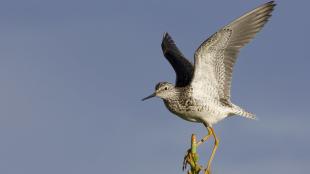
Lesser Yellowlegs, its wings raised as it balances on the slender tip of a tree in the sunlight

Singing Sandpipers

We've all seen sandpipers foraging busily on mudflats or at the ocean's edge. But this Lesser Yellowlegs often carols from the top of a tall conifer in its nesting territory in Alaska. The name "sandpiper" actually comes from the voices of these birds, rather than from their long-billed…
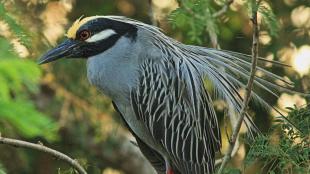
Yellow-crowned Night-Heron

Morning on the Bayou

Cypress trees draped with Spanish moss rise from still, dark water. A Barred Owl hoots mightily as an alligator slithers by. It's morning on the bayou. Bayous are found in much of the Southeast from Arkansas to Alabama, across flat land that drains into the Mississippi River. A bayou's…
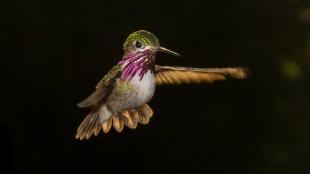
Calliope Hummingbird

The Tiny Calliope Hummingbird

The tiniest bird in mainland North America: the Calliope Hummingbird - a 3-1/4-inch jewel, weighing in at just a tenth of an ounce. These birds migrate north each spring from Western Mexico. From its perch, a male Calliope Hummingbird surveys its territory. This exquisite bird was named…
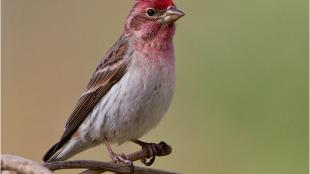
A male Cassin's Finch, with strawberry red pink head feathers, pale beige breast and dark brown wings and back.

Ponderosa Pine Savanna

In a Western ponderosa pine savanna, tall pines dot an open, grassy landscape. A Western Bluebird flits from a gnarly branch, as this Cassin's Finch belts out a rapid song. The trees here grow singly or in small stands. Upslope, the pines become denser, mixing with firs. Downhill, the…
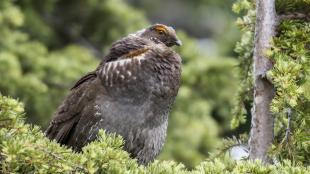
A male Sooty Grouse, perched on a branch amidst forest greenery, in his breeding plumage of dark grayish brown feathers, and orange "eyebrow" above his brown eye.

Sooty Grouse are Hooting

In spring, a male Sooty Grouse calls from a concealed perch high in a tall conifer. Known as “hooting,” it’s a very low-pitched, five or six-note thunking sound. When a female cackles in response, the male flies down and displays to her by strutting and fanning his tail. Females are…
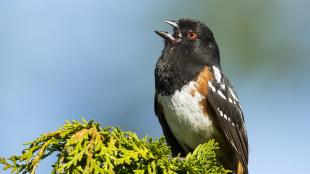
Male Spotted Towhee singing in sunlight, with his black head, throat and wing set off by his white breast and red eye.

Rachel Carson and Silent Spring

Among the most welcome features of spring is the renewal of bird song. Can you imagine a spring without the voices of birds? The silence would -- as they say -- be deafening, the absence of their songs like the loss of one of our primary senses. Rachel Carson's 1962 book, Silent Spring…
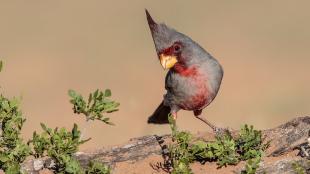
A Pyrrhuloxia facing viewer, showing it's soft gray plumage, scarlet color at throat and face, and peaked crest atop its head

Walk Down an Arroyo

Arroyo means "stream" in Spanish. With mesquite, yucca, and cactus along their edges, arroyos in the Southwest fill with water only a few times a year, mostly during the heavy rains of late summer. There's a remarkable diversity of wildlife here, including this Pyrrhuloxia. Birds here are…
Fox Sparrow with its head tipped back, beak open as it sings while perched on a branch.

Singing with Fox Sparrows

A modest thicket of trees along a street can be the perfect place to hear one of the earliest bird songs of spring: the Fox Sparrow. You can hear their loud, spirited songs from dense vegetation throughout much of the U.S. The easternmost birds have the rufous color of a Red Fox. Others…
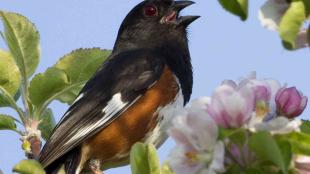
Eastern Towhee singing

Celebrating the Vernal Equinox

The vernal equinox, the first day of spring. The moment when the sun is directly above the equator, and day and night are nearly equal all over the world. Yet birds sense the growing hours of daylight through a surge of hormones. It’s time to sing! Both science and folklore tie spring to…
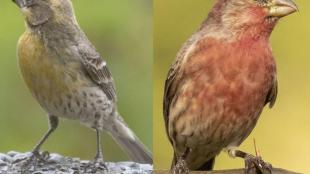
Yellow and Red House Finches

House Finches - Red and Yellow

House Finches eat many kinds of seeds and fruits. A careful look at male House Finches at a feeder shows that, while most males show red feathering, some are decidedly more orange - and some even yellow. House Finches acquire their coloration from pigments known as carotenoids in the foods…