
Image: The Ultimate Bird Drawing Throwdown Showdown Graphic featuring images of David Sibley and H. Jon Benjamin

Join BirdNote tomorrow, November 30th!

Illustrator David Sibley and actor H. Jon Benjamin will face off in the bird illustration battle of the century during BirdNote's Year-end Celebration and Auction!
RESERVE YOUR SPOT

Shows With Contributions by Mary McCann

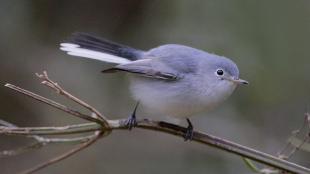
Blue-gray Gnatcatcher

Blue-gray Gnatcatcher: Little Bird with a Big Story

The slim, 4½-inch Blue-gray Gnatcatcher is found over much of the East and Midwest and in parts of the West, too. It actively searches trees and bushes for small bugs to eat, often hovering briefly and flaring a long black-and-white tail. ¡Escuche este episodio en español!
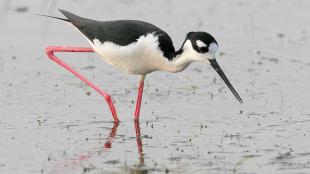
Black-necked Stilt foraging

Black-necked Stilt - The Bird with Outrageous Legs

Visit a shallow wetland in summer, and you might see this slender, black-and-white shorebird with outrageous red legs. The Black-necked Stilt uses its long legs for wading as it feeds on tiny insects and crustaceans on the surface of the water. Stilts are sensitive to drought, which has…
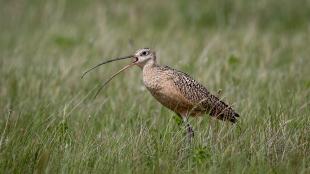
Long-billed Curlew standing in a grassy field

Shorebirds Aren't Always on the Shore

Shorebirds' lives take them to many places other than the shore. Most of the shorebirds we see along our coasts migrate to the Arctic in summer. Here, many nest on the tundra, some along rushing streams, and others on rocky mountainsides. Long-billed Curlews winter on the Florida, Gulf…
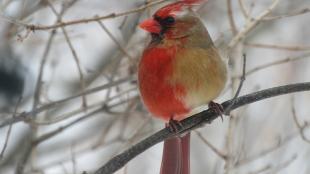
A Northern Cardinal showing male plumage coloration on its right side, female plumage coloration on its left side.

A Cardinal That's Half Male, Half Female

In Texas, Pennsylvania, and elsewhere, people have reported seeing Northern Cardinals that are red on one side and brown on the other, indicating that a bird is half male and half female. This anomaly occurs in other species of birds, as well, not just cardinals. Insects, too! Scientists…
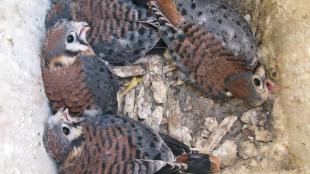
Kestrel nestlings in a nest box

Kestrels Love Nest Boxes

This American Kestrel evolved to nest in tree cavities or small caves in cliffs. We humans have made life difficult for kestrels. Development has shrunk the open spaces they need. We’ve cleared away dead trees they rely on for nests and sprayed pesticides that eliminate the insects the…
Pileated Woodpecker nest with parent and chicks

What's Inside a Woodpecker's Nest Hole?

Many woodpeckers chisel out deep cavities in tree trunks in order to lay their eggs and raise their brood. The cavities hollowed out by the birds vary in size, depending on the species of woodpecker. The chamber of a tiny Downy Woodpecker descends about a foot from the opening, while the…
Great Egret displaying its beautiful breeding plumage

Great Egret's Lacy Courtship

Male Great Egrets have special long feather plumes called aigrettes, which they use in courtship displays in the spring. These beautiful big birds were nearly hunted to extinction for these special feathers, which were used to adorn ladies’ hats. The plight of the egret spurred people to…
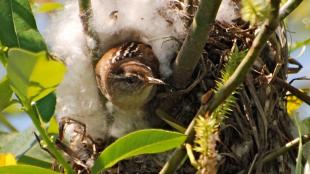
Marsh Wren peeking out of its nest

The Marsh Wren's Many Nests

Tiny Marsh Wrens live in wetlands, usually within cattails, reeds, or bulrushes. After choosing his territory, the male weaves up to 15 dome-shaped shells, lashing together cattails, grasses, or reeds. These are called "courting" nests. Then, sitting high atop a perch in the marsh, he…
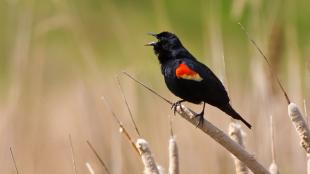
Red-winged Blackbird

Dawn in the Marsh

It's dawn in a western marsh in mid-summer, and man! Those birds are singin'! The males of more than a dozen species are staking out their territories and attracting mates. One of the noisiest of all is the Red-winged Blackbird. He sings not to attract just one mate, but to gather a whole…
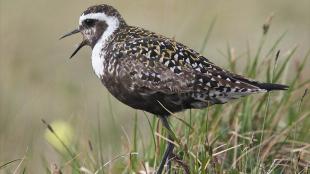
American Golden-Plover

American Golden-Plover Lays Claim to the Tundra

A male American Golden-Plover proclaims its nesting territory with an aerial display known as the "butterfly flight." After flying up 50 feet, the plover switches to slow motion, raising its wings languidly until the wingtips nearly touch over its body, then lowering them gradually until…