
Image: The Ultimate Bird Drawing Throwdown Showdown Graphic featuring images of David Sibley and H. Jon Benjamin

Join BirdNote tomorrow, November 30th!

Illustrator David Sibley and actor H. Jon Benjamin will face off in the bird illustration battle of the century during BirdNote's Year-end Celebration and Auction!
RESERVE YOUR SPOT

Shows With Contributions by Michael Stein

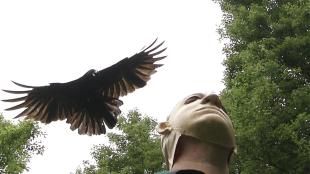
Crow attacking man in mask

Crows Recognize Individual Faces

To find out if a crow can recognize an individual human face, Professor John Marzluff of the University of Washington wore a mask while trapping, banding, and then releasing seven American Crows on campus. Later, when he walked through the campus wearing the mask, it was automatic! A big…
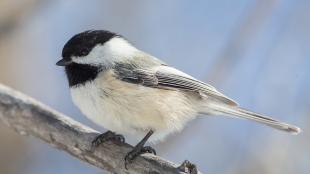
A Black-capped Chickadee displays its black "cap" coloration with grey wings and back, and pale breast and belly.

Strange Chickadee Songs of Massachusetts Islands

The song of the Black-capped Chickadee pretty much the same throughout the U.S. and Canada — with just a few exceptions, like on some Massachusetts islands. Chickadees on Martha’s Vineyard and tiny Tuckernuck Island nearby have developed songs entirely their own. It’s likely that the birds…
A small short-tailed bird with a buff-colored body, brown feathers atop its head, and a black beak sits perched in a pine tree.

Brown-headed Nuthatches of Apalachicola National Forest

Many Brown-headed Nuthatches make their home in the tall longleaf pines of the Apalachicola National Forest in Florida. Twittering constantly, the birds probe for tiny insects or extract seeds from cones in the trees’ upper branches. Forests of longleaf pine once dominated the sandy…
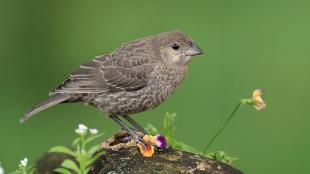
Female Brown-headed Cowbird, displaying her mottled light brown plumage and short sharp beak

Cowbird Song and Password

As most young male birds get ready to leave the nest, they learn their species’ song by hearing their male parent sing it again and again. They imprint on their father’s song. So how does a Brown-headed Cowbird, raised by parents of a different species, learn to sing the correct song? The…
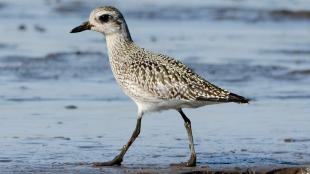
Juvenile Black-bellied Plover

Juvenile Shorebirds Head South

Like most juvenile shorebirds, this young Black-bellied Plover was abandoned by parents that began their southbound flights from the Arctic National Wildlife Refuge a few weeks earlier. It will join other young Black-bellied Plovers as they make their way south. This little flock of birds…
An American Goldfinch perched on the edge of a sunflower, the bright yellow petals matching the bird's feathers

Birds Love Sunflowers

Found throughout North America, the common sunflower can grow up to ten feet high, towering over other herbs and grasses. And that’s only half the story: their roots can reach just as deep in the soil. They’re rugged, adaptable plants that bring beauty — and food — to the ecosystem…
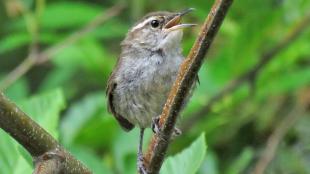
Immature Bewick's Wren

Where Do Fledglings Go?

By late summer, most birds hatched in spring are on their own, without help from their parents. Where do they go? Young migratory birds will head south in late summer or fall, in the pattern of their species. But most non-migratory birds born last spring — such as this immature Bewick’s…
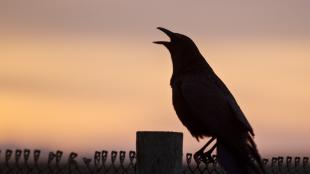
American Crow calling at sunrise

Do Crows Sing?

It’s been said that if someone knows only three birds, one of them will be the crow. They’re common, easy to see, and even easier to hear. But crow voices are complicated. Altogether, crows may use 30 sound elements in different combinations, and one of the most intriguing is their song…
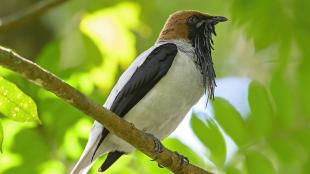
A male Bearded Bellbird perched on a branch, sunlight filtering through leaves behind it. The bellbird is seen in right profile, and the black edge of its wings contrast sharply against its white body. The head is a light cocoa brown, with black on the front of the face and the black wattles cascading from beneath its black beak.

Bellbirds Turn It Up to 11

The four species of South American bellbirds can make a real racket, including this Bearded Bellbird. Hidden in the tree canopy, males cannot see one another as they sing — but they sure can hear each other! Their ear-splitting songs carry over long distances. The loudest of the species is…
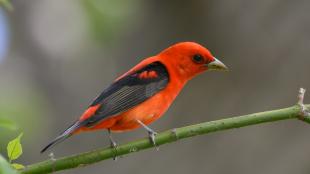
Scarlet Tanager

What's Behind Those Lustrous Red Feathers?

Male Northern Cardinals, Scarlet Tanagers, and House Finches all have striking red plumage that’s thought to play a role in attracting mates. Males with the brightest red feathering tend to have the best luck with the females. Scientists think that a male’s redness signals to females that…