
Image: The Ultimate Bird Drawing Throwdown Showdown Graphic featuring images of David Sibley and H. Jon Benjamin

Join BirdNote tomorrow, November 30th!

Illustrator David Sibley and actor H. Jon Benjamin will face off in the bird illustration battle of the century during BirdNote's Year-end Celebration and Auction!
RESERVE YOUR SPOT

Shows With Contributions by Michael Stein

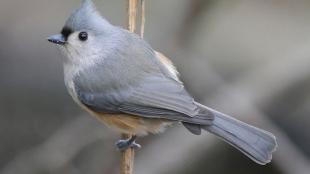
Tufted Titmouse showing its grey back and perky little crest. It's perched on a branch and looks ready for takeoff.

Tufted Titmouse - What's in a Name?

A Tufted Titmouse has just about everything you could ask for in a backyard bird. Petite and strikingly elegant, it’s as perky as a chickadee. In fact, it’s a cousin to the chickadee. And as it comes boldly to your seed or suet feeders, the Tufted Titmouse will even hang upside down like…
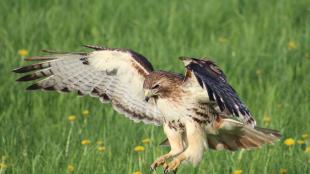
Red-tailed Hawk, wings raised as it lands on a grassy area

Red-Tailed Hawks - Adaptable Diners

Red-tailed Hawks are found year ‘round in a wide variety of natural landscapes, from meadows to forest edges, deserts, and canyons. One big reason we see Red-tailed Hawks in so many places is their remarkable adaptability as hunters. They vary their diet to what is locally abundant. So…
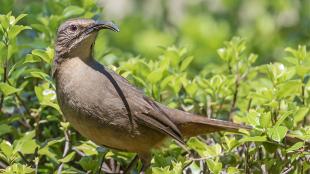
A California Thrasher, in left profile with the head turned toward the shoulder, perched in a bush in the coastal chaparral region. The California Thrasher's plumage is a soft dusty brownish gray, its eye is reddish brown and its long downward-curving beak is black.

Unique Chaparral

The dense cover of coastal chaparral supports many birds found nowhere else in the world, including this California Thrasher. The plant species are different, but the chaparral of California is much like shrubby coastal vegetation in southern Europe, South Africa, southern Australia, and…
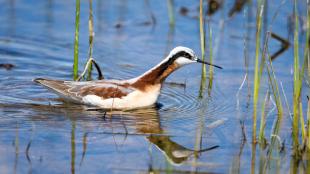
A female Wilson's Phalarope foraging in wetlands scene, her brown, grey, and white plumage reflected in the blue water. Her long neck is stretched forward, with a black stripe running up to her eye, while her long black beak leads the way.

Shorebirds in Kansas - Oval Migration Pattern

Almost half of all migratory shorebirds nesting in North America migrate through the Cheyenne Bottoms Wildlife Area in central Kansas. Almost all of the continent's Wilson's Phalaropes rest and refuel at the wetlands here. The birds fly a great oval route. In autumn, in the East, they head…
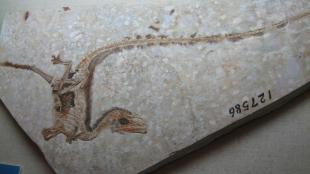
A Sinosauropteryx fossil photographed at the Henan Geological Museum, Zhengzhou, China. The body and long tail show traces of feathers preserved in the fossil.

China's Golden Age of Fossil Discovery

In the mid-1990s, a golden age of fossil discovery began in the Liaoning region of northeast China. The fossils date from 120 to 160 million years ago, when feathered dinosaurs and early birds were flourishing and differentiating. The signature fossil was the world’s first-known feathered…
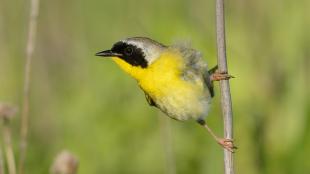
A male Common Yellowthroat clasping a vertical branch and looking to his right. His black mask and bright yellow throat and breast are sunlit.

International Migratory Bird Laws

In May, we celebrate migratory birds, including this Common Yellowthroat. The Migratory Bird Treaty Act of 1918 gave much needed protection to birds, especially migratory songbirds. In 1940, the US and 17 other countries throughout the Americas signed a pact to "protect and preserve - in…
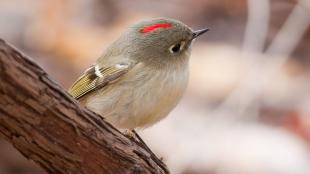
A Ruby-crowned Kinglet perched on the side of a branch, bird seen in right profile, tiny red crest showing on top of its head

Little Rickie

The Ruby-crowned Kinglet is one of North America’s tiniest songbirds. At just four inches long and weighing less than a quarter of an ounce, it’s affectionately known as “Little Rickie,” based on the official four-letter code: RCKI. But the tiny bird has a big voice—the male sings a loud…
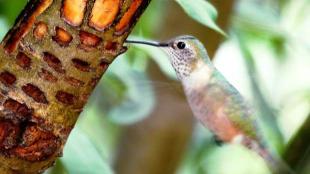
Broad-tailed Hummingbird drinking sap from tree bark

Sapsuckers and Hummingbirds

The sapsucker is a type of woodpecker that notches rows of small holes in trees, causing sap to well out. The birds eat the sugary liquid flowing from these sapwells. Tree sap is similar in sugar content to the nectar hummingbirds take from flowers. And it is no coincidence that just as…
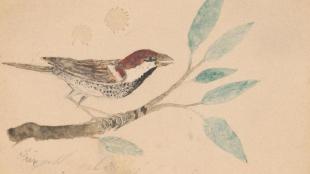
Sketch of a sparrow by a young Theodore Roosevelt

Theodore Roosevelt - Presidential Birder

Of all American presidents, just one might have halted the playing of “Hail to the Chief” so he could listen to an Orchard Oriole singing — Theodore Roosevelt, “the conservation president.” During his presidency, Roosevelt helped establish 51 preserves for birds, five national parks, 18…
Mourning Dove on the ground, wings spread out while sunning itself

Sunning with Doves

A Mourning Dove lies belly down on the soil of a garden bed. It fluffs its feathers, then relaxes its wings, draping them outward to expose fully its back and rump to the morning sun. A great many birds sun themselves, often in postures that give maximum sun exposure to the head, neck, and…