
Image: The Ultimate Bird Drawing Throwdown Showdown Graphic featuring images of David Sibley and H. Jon Benjamin

Join BirdNote tomorrow, November 30th!

Illustrator David Sibley and actor H. Jon Benjamin will face off in the bird illustration battle of the century during BirdNote's Year-end Celebration and Auction!
RESERVE YOUR SPOT

Shows With Contributions by Michael Stein

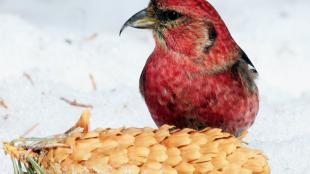
White-winged Crossbill sitting at a pinecone in snow

Crossbills Nest in Winter

In the grips of winter, when most songbirds are months away from the breeding season, crossbills are already warming up. It’s all about the food. When the evergreens hang heavy with snow and cones, crossbills can get all the calories they need for the demands of reproduction: courtship…
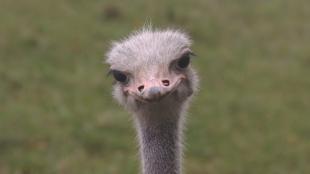
Close up of Ostrich looking into the camera

Consider the Ostrich

The flightless Ostrich is a bird of superlatives. It's the largest and tallest bird on the planet, growing to maybe eight feet tall, and weighing 250 pounds! It's also the fastest creature on two legs, capable of running at 40 miles an hour. Ostriches have never been observed to stick…
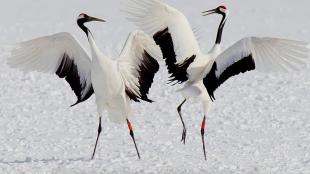
Pair of Red-crowned Cranes dancing on snowy ground

Red-crowned Cranes Dance on Hokkaido

On a snow-covered field in northern Japan, two majestic Red-crowned Cranes face one another, raise their heads toward the sky, and call in unison. As they call, the pair begins to dance. They bow to one another, then throw their heads over their backs, then bow again. The pair leaps into…
Green Kingfisher seen in profile, perched on a branch

Three Kingfishers

The Belted Kingfisher is the one species of kingfisher found throughout most of North America north of Mexico. You'll have to go to Texas to see two other kingfishers. The quiet call of the Green Kingfisher - like this one - can be heard at wooded streams and ponds. A Ringed Kingfisher…
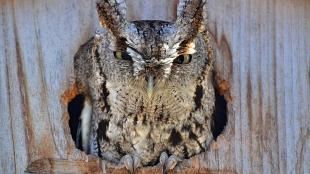
Eastern Screech Owl peering out of a wooden nest box

Screech-Owls Are Looking for a Home

Looking for a project this winter? Consider giving screech-owls a helping hand. Eastern and Western Screech-Owls span the wooded areas of the continent, nesting in tree cavities left vacant by large woodpeckers. However, such natural housing opportunities are often in short supply. That’s…
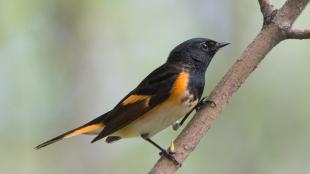
American Redstart perched on a branch

American Redstart - The Tale Is in the Tail

Who knew that this American Redstart’s feathers could reveal so much information about its life? For example, the more intense the color of a male American Redstart’s feathers, the better his chances of holding a good winter territory, which means access to good nutrition. Being well fed…
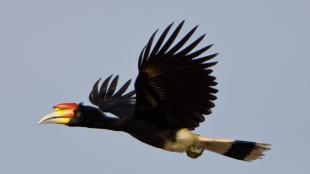
Rhinocerous Hornbill

Rhinoceros Hornbill

Rhinoceros Hornbills are among the largest of the world’s 54 species of hornbills, which are spread across Africa and India to Asia and New Guinea. Some hornbills eat mostly fruit. Others are carnivorous, snapping up lizards, small mammals, and birds. Most live in mature, tropical forests…
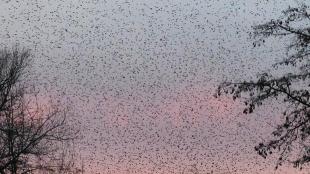
American Robins flocking en masse

61 Tons of Robins!

In winter, flocks of American Robins spend the night together. Typically, a few dozen to a few hundred birds roost communally in trees or an old barn, or under a bridge. But larger robin roosts can number in the thousands, or even tens of thousands! In 2007, observers near St. Petersburg…
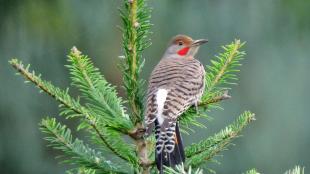
Flicker showing white in rump

The Flicker's White Rump

When a Northern Flicker takes flight, a bold patch of white feathers flashes on its rump, in contrast to its brown body. This white rump likely evolved as an anti-predator adaptation. A hawk flying in pursuit of a flicker may focus on the white spot rather than the darker image of the…
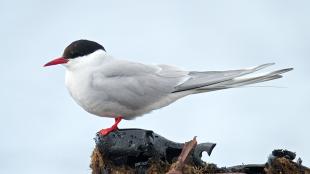
Arctic Tern

Why Arctic Terns Have Short Beaks

The bill and legs of Arctic Terns are shorter than those of Common Terns. Because Arctic Terns breed in the Arctic and winter in the Antarctic, they are subject to much colder weather than are Common Terns. Birds' bills and legs lose heat, because they're not covered by feathers. Birds in…