
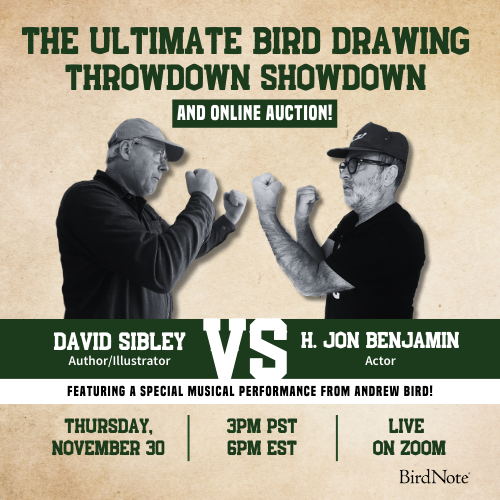
Join BirdNote tomorrow, November 30th!
Illustrator David Sibley and actor H. Jon Benjamin will face off in the bird illustration battle of the century during BirdNote's Year-end Celebration and Auction!
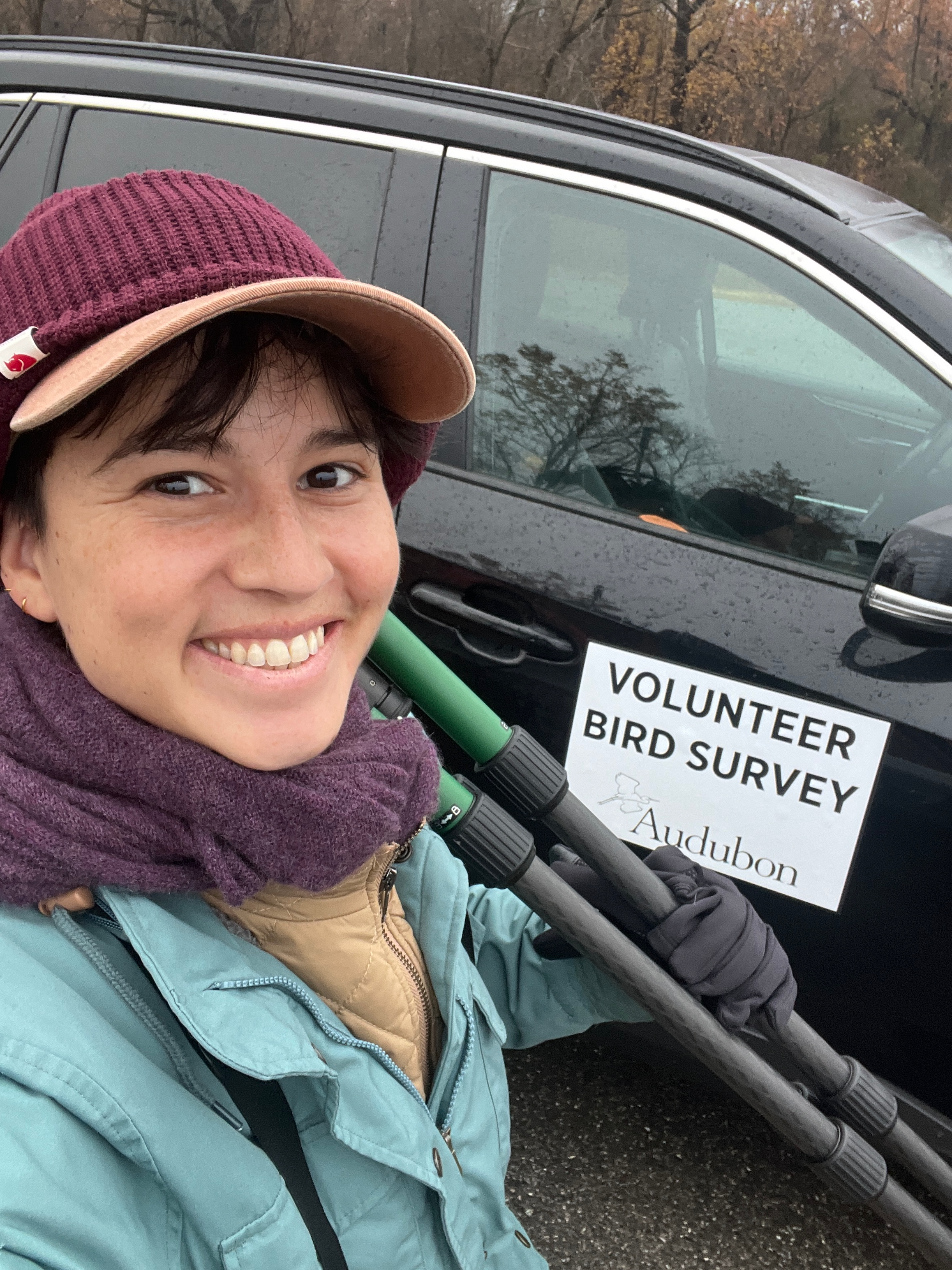
Ariana Remmel is the managing producer of BirdNote Daily and BirdNote en Español. Ari oversees the writing, editing, and development of the radio shows and supports the production of BirdNote’s longform and special projects. Their previous print and audio reporting has appeared in Science, Nature, Audubon Magazine, and elsewhere.
Ari began their career as a chemist before making the switch to science journalism; they hold an M.S. in chemistry from the University of California San Diego and a M.S. in science communication from the University of California Santa Cruz.
A lifelong nature enthusiast, Ari is rarely found without a field guide, binoculars, and a wallet-sized scale bar (in case they find a cool bug to photograph!). Ari enjoys volunteering with the National Association of Science Writers, the Central Arkansas Master Naturalists, and their local bird banding station.
We sat down with Ari to get to know them and their work here at BirdNote!
Q: How did you end up at BirdNote? What was your journey to here?
I joined BirdNote as a full-time managing producer in March of 2025, but I had been a freelance writer and narrator for BirdNote Daily since 2021. At that stage of my career, I was a science journalist primarily writing about chemistry and materials science for a variety of news magazines. But in my free time, I was birding. I realized that I could apply many of the skills I’d developed as a scientist and reporter towards becoming a better birder. I started studying field ornithology, ecology, and conservation biology – and telling anyone who would listen about the wonders of birds and nature. Then one day, as I was listening to my local public radio station in my car, I heard a fun little show with a catchy theme song. A few emails and Zoom calls later, I made my BirdNote Daily debut with a 16 episode series about migration.
Q: What does a day in your life at BirdNote look like?
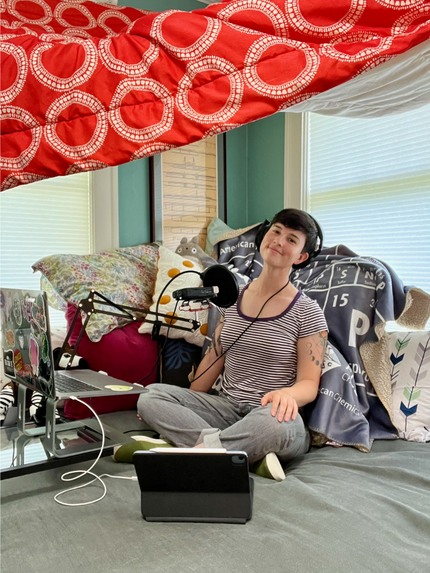
I work from a home office in Little Rock, Arkansas where I live with three (very spoiled) indoor cats. Every day starts with a cup of bird-friendly coffee, often enjoyed while watching backyard birds in my native plant garden. This morning, I observed a juvenile Northern Mockingbird follow their parent to a stand of pokeweed outside my office window and proceed to gobble down every ripe berry in sight!
The rest of my day depends entirely on where we are in the production cycle. BirdNote Daily episodes are produced in monthly batches and BirdNote en Español episodes are translated quarterly. This week in September, I’m writing scripts that will start airing in December, editing scripts that we’ll record with narrators to publish in November, and listening to all the new & rerun episodes that will air in October. I also just sent a new batch of BirdNote Daily scripts to our partners at Kizaya so that they can prepare Spanish translations for BirdNote en Español. For folks curious about the many steps involved in producing each episode of our radio shows, I highly recommend checking out the guest seminar that Executive Director Nick Bayard and I presented to the New York City Bird Alliance about “2-minute Conservation: Storytelling with BirdNote”.
Q: What was your Spark Bird?
The first bird I remember connecting with was a Mourning Dove. One morning before school, when I was about 4 years old, I noticed an unusually large smattering of bird poop on the sidewalk in front of my house. The path was shaded by a shrubby tree, so I craned my neck to see what had made such a mess. I found myself looking up at a Mourning Dove that was sitting on a nest and looking down at me. We stared at each other for as long as I could get away with, her quiet and me slack jawed. In that moment, it was the discovery of a lifetime. I checked on my new friend on my way to and from school each day. And long after she moved on, I’ve continued looking for birds – and conspicuous sidewalk white wash.
Q: What is your favorite BirdNote episode?
That is a tough question! Over the last 20+ years, BirdNote Daily has published more than 2,500 episodes. BirdNote en Español will have more than 200 episodes before the end of this year. As a writer, narrator, and producer for the radio shows, I hope I can be forgiven for highlighting more than one.
"Birdsong Mnemonics with Christian Cooper" is definitely toward the top of my list. Not only is it a quirky episode, it was also a group effort. Everyone on the production team, and several folks from other departments, worked together to make this show possible — from the interview and script development to narration and sound design.
Many people think BirdNote is synonymous with BirdNote Daily, but don’t miss out on the fabulous stories that come out on our podcast Bring Birds Back. I often highlight the longform show in excerpts on BirdNote Daily, like this beautifully sound-designed episode about "The Joy of Robins with J. Drew Lanham".
For Spanish speakers (and learners!), I recommend checking out BirdNote en Español, especially our story about a fascinating symbiosis called "Los colibríes ayudan a los ácaros a agarrar aventón" and an episode inspired by a haunting song I heard in the tropical forests of Veracruz called "Dos cueveros poco comunes cantan en el sur de México". Both episodes are also available in English.
Q: What would be your bird-themed super power?
Another tough question! Birds have some pretty incredible abilities including their incredible adaptations for flight and the physical transformations they undergo to migrate long distances. But if I had to choose just one super power, it would probably be the ability to see ultraviolet light. Many plants and animals have markings that are vibrant in the UV spectrum but invisible to the human eye. I’d love to know what the world looks like to a bird and how much more information I could glean from nature with a heightened sense of sight.
Q: What actions have you been inspired to take for birds?
Finally something easy! I already mentioned that I switched to bird-friendly coffee and started a native plant garden to support bird habitat (at home and abroad). Ever the researcher, my favorite ways to support conservation are through community science initiatives. I volunteer with eBird as reviewer for my region and with my local bird observatory as a bird banding assistant. I recently started leading a series of outings tailored to beginner birders as a way to get more people involved in conservation and to recruit volunteers for the annual Christmas Bird Count. And of course, as a BirdNote staffer, I get to introduce people across the Americas to the joy of birds by producing episodes about species of conservation concern and the actions we can all take to protect them.