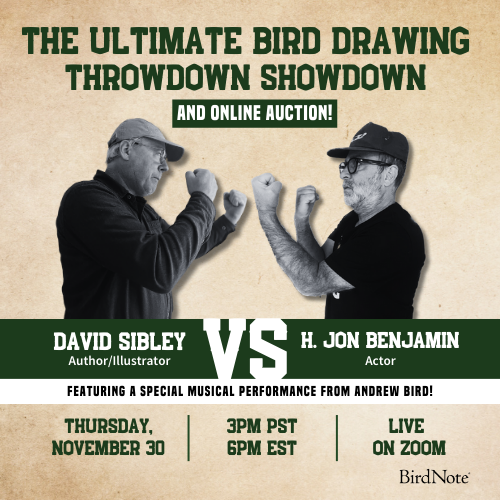
Join BirdNote tomorrow, November 30th!
Illustrator David Sibley and actor H. Jon Benjamin will face off in the bird illustration battle of the century during BirdNote's Year-end Celebration and Auction!
Calling Ducks Like A Champ
What does it take to win the World Championship Duck Calling Contest?

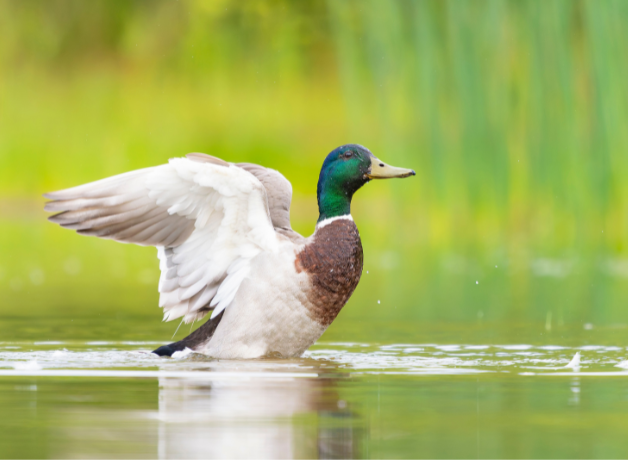

© Mick Thompson
Every November, duck callers flock to Stuttgart, Arkansas to compete in the annual World Championship Duck Calling Contest. Hunters traditionally use calls to lure in ducks by imitating the quacks and chattering of wild birds enjoying good habitat. But competition callers demonstrate their skills with a much broader repertoire. In this episode, 2025 World Champion Hayes Kibe describes what it’s like to blow for glory after becoming the youngest person to take first at just 15-years-old.
BirdNote®
Calling Ducks Like A Champ
Written by Ariana Remmel
This is BirdNote.
[Hayes Kibe performing his duck call routine]
And this is Hayes Kibe competing in the 90th World Championship Duck Calling Competition* in Stuttgart, Arkansas. When Hayes took first place in 2025, he became the youngest person to ever win at just 15-years-old.
[Hayes Kibe performing his duck call routine]
Duck calls are woodwind instruments, like the clarinet or oboe. They’re typically made from wood or acrylic, and measure about 5 inches long. Hayes started learning the craft when he was 11.
Hayes Kibe: I just saw a video on YouTube one day and I just wanted to see if I can do it.
[Kibe warming up]
Hayes Kibe: It's a lot of practicing, a lot of blowing, 'cause you wanna build up your lungs and everything. 'Cause big lungs, I mean, it counts.
Hunters traditionally use calls to lure in ducks by imitating the quacks and chattering of wild birds enjoying good habitat. But competition callers demonstrate their skills with a much broader repertoire than is typically used in the field.
Hayes Kibe: A hunting call is, I mean, is calling the ducks. It's nice, simple. And then the competition is you're trying to impress the judges. One mistake and you're out.
Those judges are listening for mastery of tone, clarity, and rhythm across four key elements.
The hail call:
[Hail call]
Feeding calls:
[Feeding calls]
The “Come Back Call,” a variation of the hail call:
[Comeback “triple” call]
And a lone duck call:
[Quack]
Essentially a quack.
Over several elimination rounds, each contestant has only 90 seconds to blow for glory.
Hayes Kibe: It's, uh, very nerve wracking. It's very, I'm very nervous up there, but I'll just fight through it and I just get it done.
[Hayes Kibe performing his duck call routine]
Those nerves hardly showed when young Hayes outperformed more than 60 competitors in November of 2025.
Announcer: Our 2025 90th Annual World's Championship Duck Calling Contest, Mr. Hayes Kibe, everybody!
[Loud, cheering applause]
Now, with one world championship under his belt, Hayes has already set his sights on his next competition.
For BirdNote, I’m Ariana Remmel.
[Lone duck calls at the end of a routine]
###
Senior Producer: Mark Bramhill
Producer: Sam Johnson
Managing Producer: Jazzi Johnson
Managing Producer: Ariana Remmel
Content Director: Jonese Franklin
BirdNote’s theme was composed and played by Nancy Rumbel and John Kessler.
©2026 BirdNote November 2026
Narrator: Ariana Remmel
ID# KibeH-01-2026-11-02 KibeH-01
Reference:
https://www.stuttgartduckfest.com/duck-calling-championship
*Editor's note: The official title of the event is the World Championship Duck Calling Contest, not Competition as named in the script.