
Image: The Ultimate Bird Drawing Throwdown Showdown Graphic featuring images of David Sibley and H. Jon Benjamin

Join BirdNote tomorrow, November 30th!

Illustrator David Sibley and actor H. Jon Benjamin will face off in the bird illustration battle of the century during BirdNote's Year-end Celebration and Auction!
RESERVE YOUR SPOT

Shows With Contributions by Bob Sundstrom

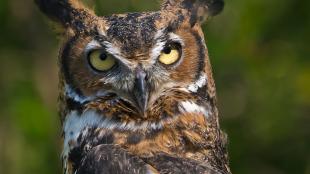
Great Horned Owl

Voices and Vocabularies - Great Horned Owls

Great Horned Owls have a lot to say! When a pair of Great Horned Owls calls in a duet, the female usually hoots first, and the male replies at a lower pitch. Great Horned Owls may also pierce the darkness with an eerie shriek, which may signal a hungry owlet begging for food or a female…
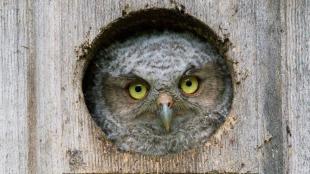
Screech Owlet in nestbox

Screech-Owls Go Fishing

Screech-owls are opportunistic diners. In the Pacific Northwest, they’ll prey on small birds, crayfish, large ants, or earthworms. In Arizona, pocket mice and pack rats. And in Ohio, biologists who noticed a fishy smell around Eastern Screech-Owl nest boxes found the remains of dozens of…
Rose-breasted Cockatoo

Stowaway Cockatoo Takes a Cruise

A beautiful Rose-breasted Cockatoo named Harri took the adventure of a lifetime. She set off unseen on a cruise ship from Brisbane, Australia, and wasn’t discovered until the ship neared New Zealand. Authorities there were not happy to see Harri, whose species is the bane of farmers in her…
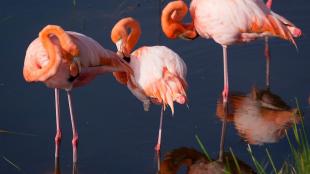
Greater Flamingos in the Galapagos

Just What Are Flamingos?

Few birds are as distinctive as flamingos. Scientists once grouped flamingos with storks and ibises. But a study of flamingo DNA delivered a stunning surprise: their closest living relatives appear to be grebes. And an even bigger surprise: DNA indicates that flamingos and grebes share an…
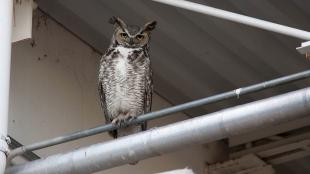
Great Horned Owl perched on railing in urban area

City Owls

Some owls, like Barred Owls and Great Horned Owls, live in the city. As hunters, they find a lot to eat in the city — like rats or squirrels! Both favor urban parks, cemeteries, and botanical gardens — places with big trees — and both roost during the day. The Great Horned Owl, like this…
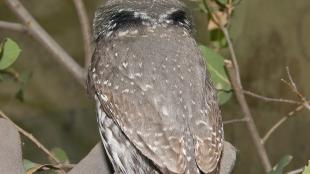
Northern Pygmy Owl, showing "eyes" on back of head

Pygmy-Owls' False Eyes

This Northern Pygmy-Owl appears to have eyes in the back of its head. But why? One theory is that large false eyes may create the illusion that the owl is much bigger than its 6 and 3/4-inch size. A more current theory is that the false eyes help protect the pygmy-owl's true eyes. Small…
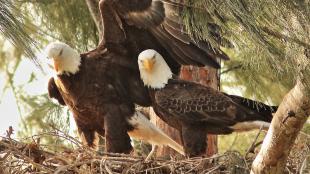
Pair of Bald Eagles in nest

Birds of Prey and Nesting Territories

Red-tailed Hawks typically have a nesting territory of about a half-mile to a full square mile, depending on how much food there is. Bald Eagles’ nesting territories range from 2½ square miles to as much as 15 square miles, for the same reason. But the Gyrfalcons in Finland and Scandinavia…
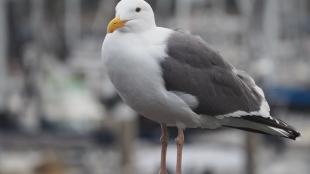
Western Gull

Gull Identification II

The challenge of learning which gull is which brings to mind a crossword puzzle. Take in all the clues, and come up with the right answer. For identifying gulls, we recommend a good bird book, binoculars, perhaps a thermos of hot coffee, and maybe a chair. So which gull is this? Large gull…
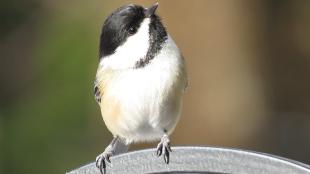
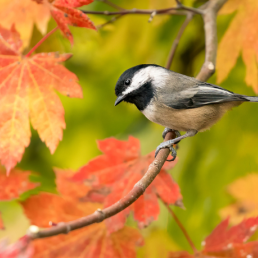
Black-capped Chickadee

Chickadee Brains Are Bigger in the Cold

As the colder months arrive, birds that remain in northern climates face the harsh realities of staying warm and finding food. Some birds approach the food problem by storing it in advance — a behavior called caching. Chickadees, nuthatches, jays, and some woodpeckers are known to cache…
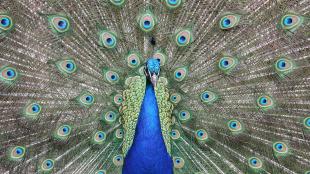
Male Peacock faces the viewer, his tail fanned out in display

The Peacock's Tail: More Than Meets the Eye

When a male Indian Peafowl unfurls its magnificently-colored tail and shakes it, it creates an ultra low frequency sound that we humans can’t hear. But it seems to get the special attention of female birds, called peahens.