
Image: The Ultimate Bird Drawing Throwdown Showdown Graphic featuring images of David Sibley and H. Jon Benjamin

Join BirdNote tomorrow, November 30th!

Illustrator David Sibley and actor H. Jon Benjamin will face off in the bird illustration battle of the century during BirdNote's Year-end Celebration and Auction!
RESERVE YOUR SPOT

Shows With Contributions by Bob Sundstrom

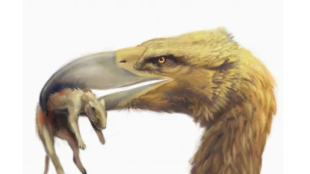
An artists rendition of Titanus walleri holding prey in its massive bill.

When ‘Terror Birds’ Ruled the Earth

A bird known as Titanis walleri made its home in Florida just a few million years ago. Titanis, as its name suggests, was titanic indeed — a flightless predator, 5 feet tall, with a massive hooked bill. Titanis and other birds related to it belong to a group some paleontologists call the…
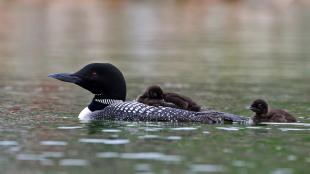
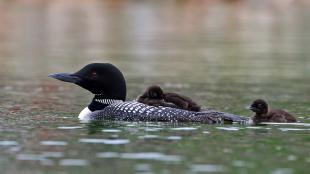
Common Loon with chicks

Birds Move from Fresh to Salt Water

To hear a Common Loon in the wild during summer, you’ll need to find a northern, freshwater lake where a pair is nesting. But to find that same Common Loon in winter, you’ll likely need to look on a saltwater bay. This shift from fresh to salt water would kill most animals. But loons —…
Un colimbo adulto nada con polluelos peludos

Aves pasan de agua dulce a salada

Para escuchar a un colimbo común ( Gavia immer) en la naturaleza durante el verano, tendrás que buscar un lago de agua dulce en el norte, donde haya una pareja anidando. Pero para encontrar ese mismo colimbo en el invierno, probablemente tendrás que buscarlo en una bahía de agua salada…
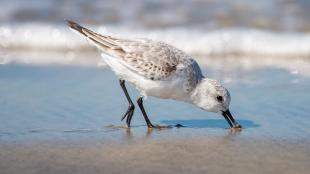
A Sanderlin in right profile while it buries its bill in wet sand while feeding, the foam of a wave's edge in the background.

Dining with Sanderlings

While many shorebirds have gone south, tiny sandpipers called Sanderlings are easy to find on winter shores. They follow the waves as they lap in and out, probing the swirling sand for prey. They often eat various small crustaceans such as mole crabs, isopods, and amphipods. But they also…
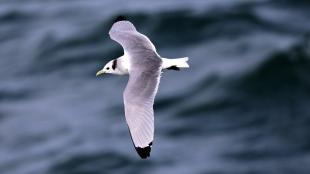
Black-legged Kittiwake

Kittiwake, Kittiwake

Named for its rhythmic calls, the Black-legged Kittiwake is a dapper, oceanic gull. As described by conservationist Roger Tory Peterson, the tips of its pale gray wings "are cut straight across, as if they had been dipped in ink." Unlike many gulls, kittiwakes spend most of the year at sea…
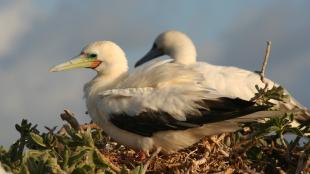
Pair of Red-footed Boobies perched in nest, with partly cloudy sky in background

Seabirds, Trees and Coral

Palmyra Atoll is a ring-shaped island encircling a lagoon in the South Pacific. The atoll lost many native trees due to U.S. military activity during World War II. Conservationists have worked to restore the ecosystem. Seabirds such as Black Noddies and Red-footed Boobies nest in the…
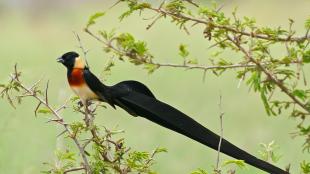
A male Paradise Whydah bird showing the extremely long tail feathers grown during breeding season

Paradise-Whydah

A few times each year, the Eastern Paradise-Whydah puts on his party clothes. This small finch is found in East Africa, and males and females generally share the same nondescript appearance. But when it’s time to mate, the male sprouts extravagant, long, black tail feathers two or three…
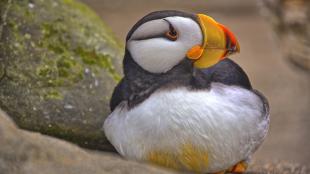
A Horned Puffin, with white breast and face and large short yellow and orange beak, sits on a rocky ledge, looking to its right.

In Winter, Puffins Lead Very Different Lives

Every summer, puffins — like this Horned Puffin — grow blazingly colorful layers over the bases of their huge beaks. But in the winter, puffins lead very different lives, and they shed their bright ornamentation. Puffins in winter are largely solitary — and silent. They spend about seven…
Crane Hawk perched in tree top

Double-jointed Hawks and Convergent Evolution

Crane Hawks of Central and South America and African Harrier-Hawks both have legs that bend forward and backward. Each bird’s wonderfully peculiar leg adaptation is completely original — it evolved all on its own — even though the end result is the same. It's a fascinating example of a…
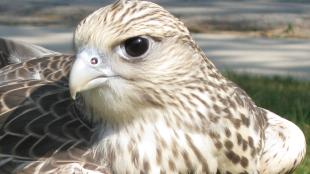
Vista cercana de un halcón de color pálido

El halcón gerifalte: Un rapaz circumpolar

Los halcones gerifaltes (F alco rusticolus) son aves circumpolares que anidan en las regiones más remotas del norte de Asia, América del Norte y Europa, incluyendo Islandia y Groenlandia. Estas aves evolucionaron como una especie distinta durante el Pleistoceno, hace unos 100,000 años. Su…