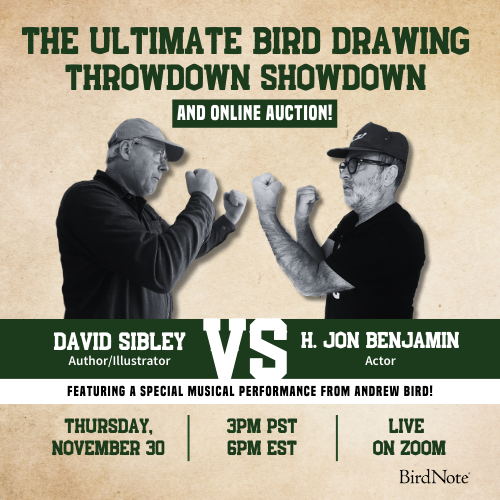
Image: The Ultimate Bird Drawing Throwdown Showdown Graphic featuring images of David Sibley and H. Jon Benjamin

Join BirdNote tomorrow, November 30th!

Illustrator David Sibley and actor H. Jon Benjamin will face off in the bird illustration battle of the century during BirdNote's Year-end Celebration and Auction!

RESERVE YOUR SPOT

Shows With Contributions by Mary McCann

Crane Hawk perched in tree top

Double-jointed Hawks and Convergent Evolution

Crane Hawks of Central and South America and African Harrier-Hawks both have legs that bend forward and backward. Each bird’s wonderfully peculiar leg adaptation is completely original — it evolved all on its own — even though the end result is the same. It's a fascinating example of a…
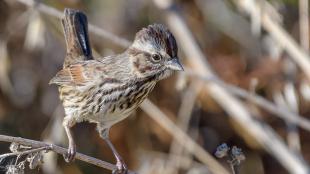
Song Sparrow seen in right profile, its tail flicking up, while perched on a branch

Why Do Birds Flick Their Tails?

The way that some birds flick, wag, or flare their tails can be distinctive. A flicking or flashing tail might suggest to a predator that a bird is particularly alert or hard to catch, while also warning others in the flock of danger. Tail flicking can also help flush out prey. A Hooded…
Bluejay and Northern Cardinals at a bird feeder in the snow

Pulling Rank at the Bird Feeder

Bird feeders full of seeds or suet can spark nonstop action. Chickadees flitter in and out. Finches expertly crack one seed after another, while jays, doves, woodpeckers and sparrows all join the flurry. This might bring to mind a neighborly picnic — but it’s not quite as friendly. At any…
Red-breasted Nuthatch and White-breasted Nuthatch

Clever Nuthatches

Of the four nuthatch species living in the United States, the most common are the Red-breasted Nuthatch and the White-breasted Nuthatch. The nuthatch's insistent call matches its aggressiveness. As they work their way down a tree trunk, nuthatches can spot — and eat — all the tasty morsels…
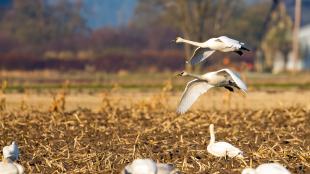
Trumpeter swans landing in a field of harvested crops stubble in Skagit Valley, WA

Swans Come Calling

Trumpeter Swans are among the world's largest flying waterfowl. They can weight up to 25 pounds and have a wingspan of nearly seven feet! These swans migrate in family groups each fall from nesting sites in Canada and Alaska to wintering grounds in the central U.S. Trumpeter Swans are…
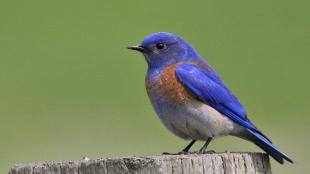
Western Bluebird

State Birds

All 50 states and the District of Columbia have official birds. To become a state bird, it helped to be familiar, colorful, and have a punchy song. The Northern Cardinal perches as state bird in seven eastern states, the Western Meadowlark in six western states. Bluebirds — like this…
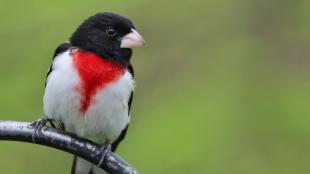
Rose-breasted Grosbeak

Beaks and Grosbeaks

Beaks suited for opening tough, hard seeds — thick, conical beaks — evolved in more than one lineage of birds. Rose-breasted Grosbeaks are related to cardinals, which also have powerful beaks. Evening Grosbeaks belong to the finch family, which includes goldfinches and crossbills — an…
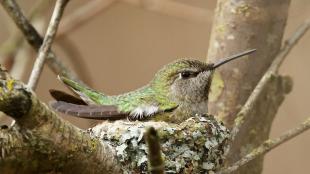
An Anna's Hummingbird sitting on a nest

Stand-still Birding

While full-speed-ahead birding can mean spotting a large number of species, there's quiet joy in stand-still birding. Pick a place-forest, field, or marsh. Find a seat that's dry, and hold your binoculars to your eyes. Be still and blend in. After perhaps 20 minutes, birds accept you as…
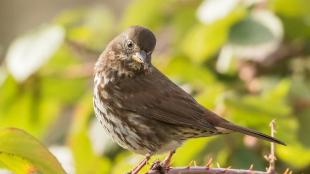
Fox Sparrow perched on a thorned branch in partial sunlight

Creating an Inviting Habitat

Bird feeders and birdbaths are great ways to attract birds to your yard, but they aren’t the only ways to entice our feathered friends. Planting an area densely with native shrubs, trees, and other vegetation can create a natural look that some birds are more likely to feel at home in…
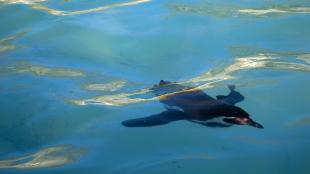
Humboldt Penguin swimming below the water's surface

Why Are There Flightless Birds?

The ability to fly seems to define birds. But there are more than 50 species of flightless birds throughout the world — from the Ostrich and Kiwi to flightless rails, ducks, and this Humboldt Penguin. Why did they evolve the inability to fly? Many dwelt on islands. Others evolved until…