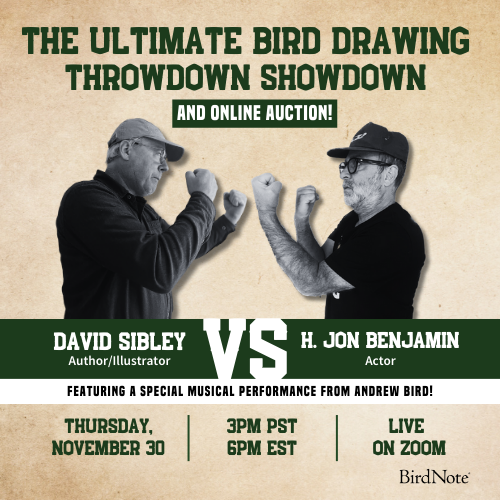
Join BirdNote tomorrow, November 30th!
Illustrator David Sibley and actor H. Jon Benjamin will face off in the bird illustration battle of the century during BirdNote's Year-end Celebration and Auction!
What's with the Wattles?
Many birds, like male turkeys, have wattles. What are they for?

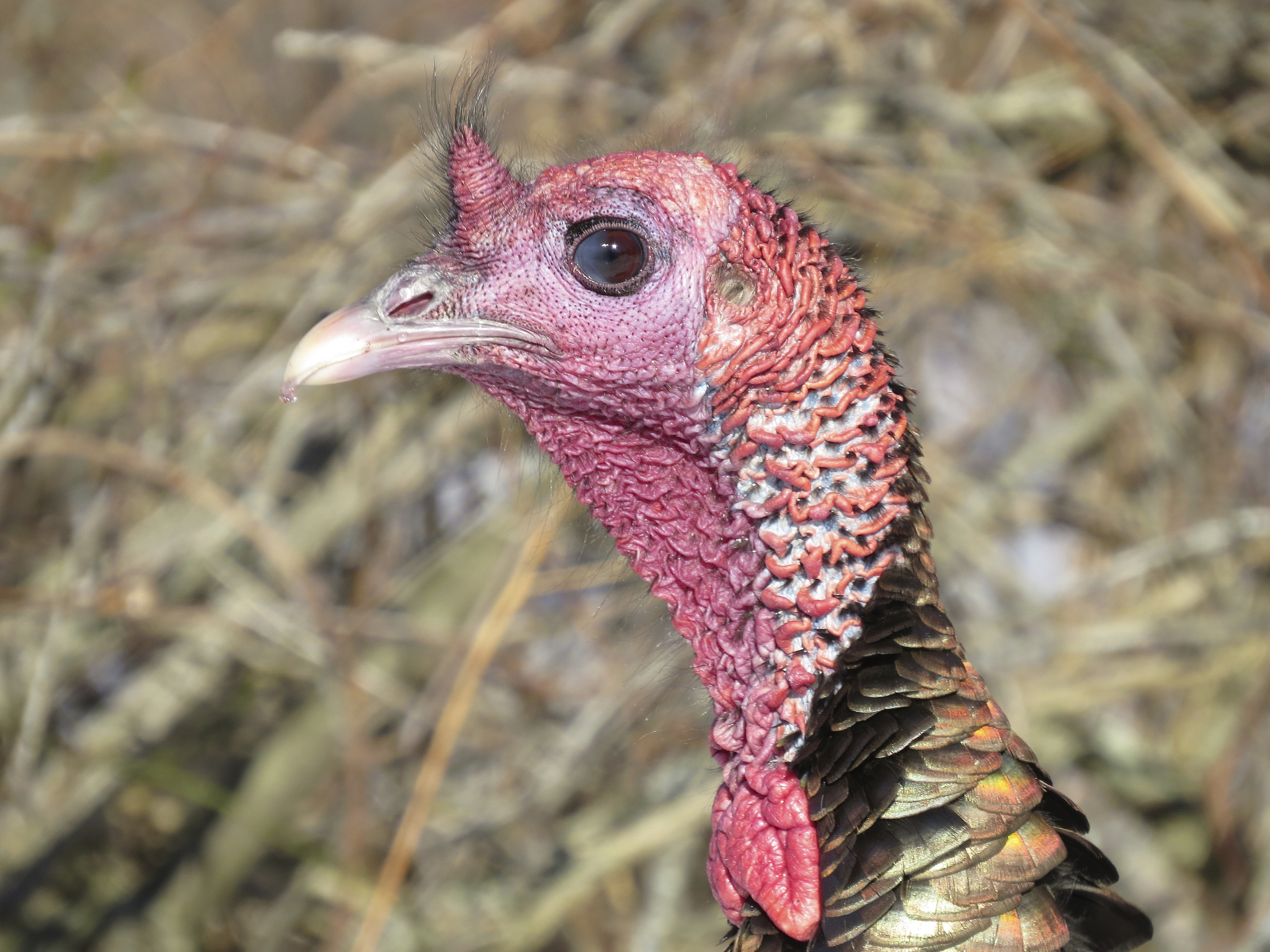

© Colleen Prieto
Birds like male turkeys or barnyard roosters have a wrinkly, bumpy flap of red skin called a wattle. But what are wattles for? Birds can’t sweat, so wattles help release excess heat. Wattles are also key to courtship displays. Many other birds, including some storks and plovers, also have wattles.
BirdNote®
What’s with the Wattles?
Written by Bob Sundstrom
This is BirdNote.
Take a close look at a male Wild Turkey—if you dare.
[Turkeys calling and gobbling throughout]
This turkey is a hefty four feet of bird, tail tip to beak. Its handsome dark and densely feathered body is topped by a bare neck. And there, dangling from the chin, is a wrinkly mass of bumpy, warty-looking red skin: the wattle.
Why have a wattle? Wattles are an adaptive feature that come in handy in several ways. On a hot day, with the sun bearing down, the bare skin of neck and wattle helps release excess heat. Birds don’t sweat — they can’t sweat — so the turkey is otherwise trapped in its dense, dark feathers.
Wattles have other roles to play. When the male turkey gets to courting the hens, the wattle takes center stage. Extra blood rushes in, and the wattle glows bright scarlet for maximum visual impact.
If a predator appears, sparking a moment of fear, the blood may retract from the wattle, turning it blue.
Many birds have wattles, including some storks, plovers, pheasants, bellbirds, cassowaries, and, of course, the rooster in the barnyard.
Are they pretty? In the right bird’s eye, no doubt.
For BirdNote, I’m Michael Stein.
Did you know you can listen to BirdNote in your podcast app? Subscribe to BirdNote Daily, and never miss an episode.
###
Senior Producer: Mark Bramhill
Producer: Sam Johnson
Managing Producer: Jazzi Johnson
Managing Producer: Ariana Remmel
Content Director: Jonese Franklin
Bird sounds provided by The Macaulay Library of Natural Sounds at the Cornell Lab of Ornithology, Ithaca, New York. Turky sounds [ML74381151] ecorded by David McQuaid and [ML73964601] by James Holmes.
BirdNote’s theme music was composed and played by Nancy Rumbel and John Kessler.
© 2018 BirdNote February March 2018/2019 & November 2023/2026
Narrator: Michael Stein
ID# wattle-01-2019-2-28 wattle-01

Bob Sundstrom
Writer
Michael Stein
NarratorSights & Sounds