
Image: The Ultimate Bird Drawing Throwdown Showdown Graphic featuring images of David Sibley and H. Jon Benjamin

Join BirdNote tomorrow, November 30th!

Illustrator David Sibley and actor H. Jon Benjamin will face off in the bird illustration battle of the century during BirdNote's Year-end Celebration and Auction!
RESERVE YOUR SPOT

Shows With Contributions by Bob Sundstrom

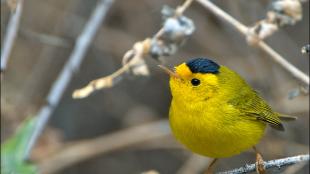
Wilson's Warbler showing its bright yellow chest and face with black "cap" coloration on its head

Wilson's Warblers Benefit from Shade-grown Coffee

Early this fall, the tiny Wilson's Warbler began its long migration to Belize, where it winters. Navigating by the stars, the 1/4-ounce bird made a series of night flights spanning more than 2500 miles. This warbler returns to the same coffee plantation each year. Taller trees that shade…
Common Loon diving

Diving Birds – Below the Surface

By December, an array of diving birds that nested at far northern latitudes are wintering on temperate waters across the continent. If we could watch them under water, we'd see this Common Loon racing like a torpedo. A goldeneye dives under water and swims about 10 feet from the surface…
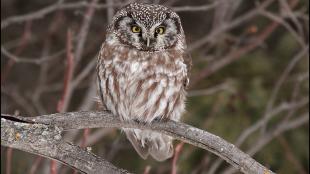
Boreal Owl facing forward, perched on a branch

Are Northern Forest Owls Coming South This Winter?

The boreal forest stretches across Canada and Alaska, a huge expanse of woods, wetlands and wilderness. And it’s full of magnificent forest owls that depend on mice and other rodents for food. Those populations can boom and bust, so in lean years, hungry owls often fly as far south as the…
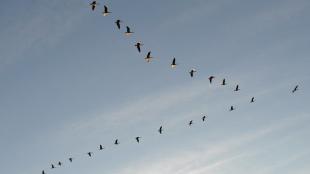
A flock of geese flying in V formation across a partly cloudy sky

Geese in V-formation

Autumn…and geese fly high overhead in V-formation. But what about that V-formation, angling outward through the sky? This phenomenon — a kind of synchronized, aerial tailgating — marks the flight of flocks of larger birds, like geese or pelicans. Most observers believe that each bird…
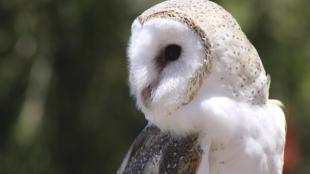
Barn Owl

Three Worldwide Raptors

Consider three species of raptors: the Barn Owl, Peregrine Falcon, and Osprey. They’re on every continent except Antarctica. Each has a specialized hunting prowess distinct from the other. They can fly great distances. And like many birds of prey, they mate for life. The Barn Owl, pictured…
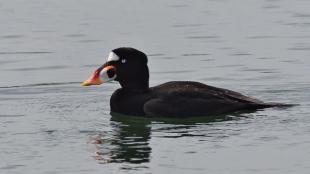
A male Surf Scoter floating on water, facing viewer's left

Surf Scoters Stand Out

Surf Scoters are large colorful sea ducks. The male Surf Scoter’s huge red-orange bill with its white and black spots really stands out. It is a great tool for eating hard-shelled mollusks like clams and mussels. Surf Scoters spend the winter along the coastlines of North America. Look at…
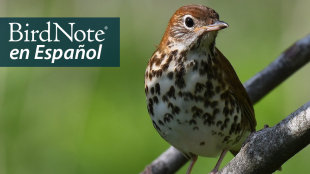
A Wood Thrush is perched on a tree branch in front of a green background. "BirdNote en Español" appears in the top left corner.

Un ave migra hacia el sur, paso a paso

Los zorzales del bosque recorren más de tres mil kilómetros de ida y vuelta cuando migran desde los territorios donde se reproducen en el verano, en Estados Unidos y Canadá, hasta donde pasan sus inviernos en América Central. Durante su migración, las aves volarán cientos de kilómetros…
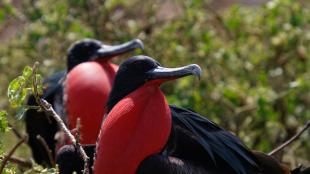
Great Frigatebirds

Frigatebirds - Seabirds That Can't Get Wet

Frigatebirds are seabirds, but one thing you’ll never see is a frigatebird floating on the ocean. Why not? Because their feathers, unlike those of nearly all other seabirds, are not waterproof. Instead, frigatebirds are masters of staying aloft. They soar above the ocean, riding a complex…
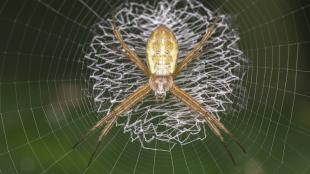
An orb spider sits in the middle of its web, which shows a central pattern of thickened fibers

Designing a Spider Web to Evade Bird Collision

One of the lesser known hazards of a bird’s life — when flitting from shrub to shrub — is collision with spiders’ webs. And when a bird flies through a web, it’s the spider’s hard work that takes the hit. It can take a spider an hour just to repair the damage and get on with the task of…
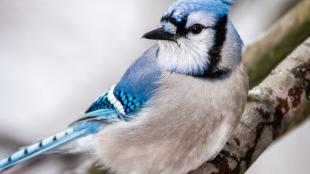
Blue Jay facing forward, looking to its right. Pale gray breast with light and dark blue markings on head and wings.

Meet the Blue Jay

If we had to pick one bird’s voice to symbolize our Eastern woodlands, the Blue Jay’s voice would likely be it. And as a frequent visitor to back yards and bird feeders, the Blue Jay is among the most recognized birds of the region. Nearly a foot long, Blue Jays can be loud and assertive…