
Image: The Ultimate Bird Drawing Throwdown Showdown Graphic featuring images of David Sibley and H. Jon Benjamin

Join BirdNote tomorrow, November 30th!

Illustrator David Sibley and actor H. Jon Benjamin will face off in the bird illustration battle of the century during BirdNote's Year-end Celebration and Auction!
RESERVE YOUR SPOT

Shows With Contributions by Michael Stein

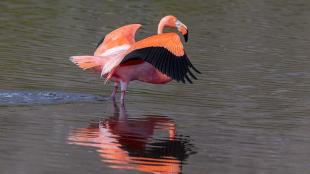
A bright pink-orange flamingo stands in water with wings outstretched, showing the black feathers along their edges

Melanin Makes Feathers Stronger

Many species have black feathers on the trailing edge of their wings, regardless of what color most of their feathers are. Birds as different as gulls, pelicans, storks, and flamingos all have black-tipped wings. These flight feathers are rich in a pigment called melanin. But melanin doesn…
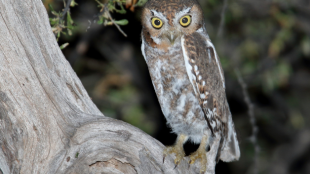
Elf Owl stands on tree

Meet the Tiniest Owl in the World

Standing less than six inches tall, with gray feathers and big yellow eyes, the Elf Owl weighs less than an ounce and a half — that’s a bit less than a golf ball. But don’t let their size fool you. The Elf Owl hunts beetles, crickets, and spiders, plus the odd lizard or mouse. Even larger…
A small iridescent blue bird with dark wings flies over lightly rippled water

Adaptations for Flight

Birds evolved not only wings, but many other adaptations that make it possible to fly. Feathers provide insulation, waterproofing, and a lightweight means to become airborne. Birds have honeycombed or hollow bones, reducing body weight. And instead of weighty jawbones and teeth, birds…
Turkey Vulture and Zone-tailed Hawk

Zone-tailed Hawks Mimic Vultures

Zone-tailed Hawks of the American Southwest look a lot like Turkey Vultures. And they often soar among groups of Turkey Vultures. By consorting with vultures, Zone-tailed Hawks gain a distinct advantage as predators. While doves and lizards would quickly flee the flight silhouette of a Red…
A clear view of the full moon in a black sky

Black Swifts Reach for the Moon

Tracking devices revealed that Black Swifts spent over 99% of their time in the air during the winter, almost never touching the ground for months. What’s more, the swifts flew to incredible heights, reaching the highest altitudes on nights when the moon was full – sometimes over 13,000…
Male Yellow-bellied Sapsucker perched on diagonal branch, looking over his right shoulder

Drumming with Woodpeckers

Like a jazz player beating out a drum roll, a woodpecker uses its bill to rap out a brisk series of notes. Early spring resounds with the percussive hammering of woodpeckers. Their rhythmic drumming says to other woodpeckers, "This is my territory!" We also hear them knocking on wood when…
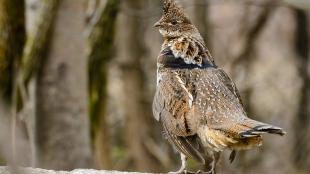
A male Ruffed Grouse standing on a log, with trees in the background

Poisonous Birds

The world is full of poisonous creatures. Some butterflies, beetles and frogs use bright colors to warn birds and other predators that they’re full of toxins. But you might be surprised to learn that some birds are poisonous, too. Birds called Hooded Pitohuis carry toxins produced by a…
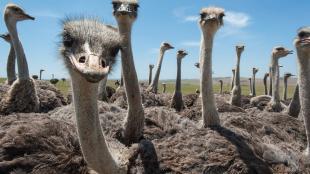
A flock of ostriches all looking into the camera, with blue sky in the background

Fastest Bird on Two Legs

Imagine an Ostrich, an Emu, a roadrunner, and the world’s fastest man and woman, all lined up for a race. Olympic sprinter Usain Bolt holds the men’s record for the 100-meter dash — 28 mph — and Florence Griffith-Joyner ran it just a shade slower. But in this race, Africa’s Ostrich takes…
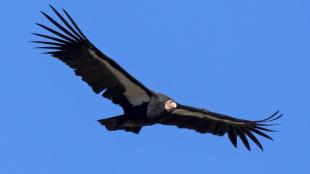
California Condor in flight, its wide wings outstretched against a clear blue sky

Female Condors Have Offspring Without Males

A captive breeding program has helped set California Condors on the path to recovery. But when biologists reviewed the family tree for the breeding program, they found a big surprise. Two chicks had DNA that linked them perfectly to their mothers but didn’t match a single male. They arose…
Black-billed Magpie showing its black head and beak, white breast, iridescent blue green wings and white shoulder

Black-billed Magpie

The Black-billed Magpie is a familiar sight throughout much of the west. The magpie's bulky nest is a rough sphere of sticks nearly three feet across, with entrance ports on the sides. Take a field trip with your local Audubon and see what you can see!