
Image: The Ultimate Bird Drawing Throwdown Showdown Graphic featuring images of David Sibley and H. Jon Benjamin

Join BirdNote tomorrow, November 30th!

Illustrator David Sibley and actor H. Jon Benjamin will face off in the bird illustration battle of the century during BirdNote's Year-end Celebration and Auction!
RESERVE YOUR SPOT

Shows With Contributions by Bob Sundstrom

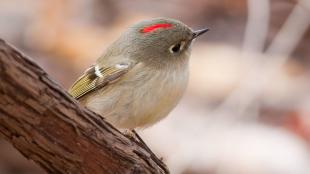
A Ruby-crowned Kinglet perched on the side of a branch, bird seen in right profile, tiny red crest showing on top of its head

Little Rickie

The Ruby-crowned Kinglet is one of North America’s tiniest songbirds. At just four inches long and weighing less than a quarter of an ounce, it’s affectionately known as “Little Rickie,” based on the official four-letter code: RCKI. But the tiny bird has a big voice—the male sings a loud…
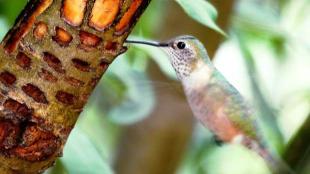
Broad-tailed Hummingbird drinking sap from tree bark

Sapsuckers and Hummingbirds

The sapsucker is a type of woodpecker that notches rows of small holes in trees, causing sap to well out. The birds eat the sugary liquid flowing from these sapwells. Tree sap is similar in sugar content to the nectar hummingbirds take from flowers. And it is no coincidence that just as…
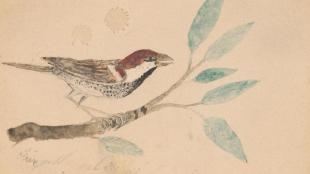
Sketch of a sparrow by a young Theodore Roosevelt

Theodore Roosevelt - Presidential Birder

Of all American presidents, just one might have halted the playing of “Hail to the Chief” so he could listen to an Orchard Oriole singing — Theodore Roosevelt, “the conservation president.” During his presidency, Roosevelt helped establish 51 preserves for birds, five national parks, 18…
Mourning Dove on the ground, wings spread out while sunning itself

Sunning with Doves

A Mourning Dove lies belly down on the soil of a garden bed. It fluffs its feathers, then relaxes its wings, draping them outward to expose fully its back and rump to the morning sun. A great many birds sun themselves, often in postures that give maximum sun exposure to the head, neck, and…
Wilson's Snipe seen in left profile, its long beak and varied brown and gold plumage offset by a white belly.

Snipe Hunt

One of the most ethereal of spring sounds is that made by the Wilson's Snipe. Much as if they were playing a reed instrument, the male snipe produces a winnowing sound in flight by metering, with his wings, the flow of air over his tail-feathers. Among the most venerable of practical jokes…
Eurasian Magpie in the sunshine, seen in right profile, perched on a fence; it's crisp black, blue and white plumage shining

The Thieving Magpie?

Rossini’s 1815 opera, The Thieving Magpie, tells of a household maid who nearly goes to the gallows for stealing silver from her employers. At the last instant, it’s revealed that the thief was actually a magpie. The opera was so popular in its day that it’s believed to have helped cement…
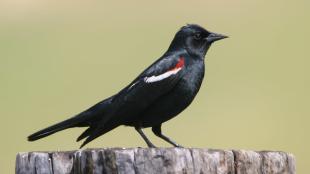
A Tricolored Blackbird seen in right profile, its black body shining in the sun, the wing showing a red patch with a white line beneath it.

Tricolored Blackbirds Face the Future

Tricolored Blackbirds nest primarily in California, but smaller groups breed from the state of Washington to Mexico’s Baja California. They look a lot like Red-winged Blackbirds, except Tricolored males have dark red epaulets and white bars on their wings instead of scarlet epaulets and…
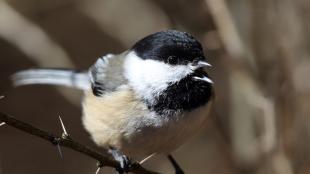
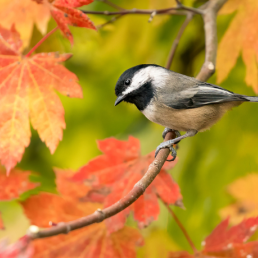
Black-capped Chickadee singing, perched on a branch in sunshine

Voices and Vocabularies - Clever Chickadees

Few backyard birds are as beloved as the Black-capped Chickadee. The boldly patterned chickadee is perky, trusting – and it seems to introduce itself by calling its name – chick-a-dee. But when a chickadee voices its namesake call – using a host of variations – it’s most likely maintaining…
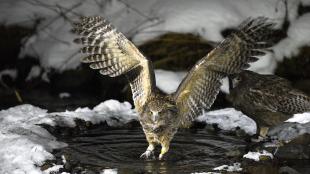
Pair of Blakiston's Fish Owls, one watching as the other fishes in a snowy pool, its wings outspread

Blakiston's Fish-Owl

The Blakiston's Fish-Owl is the largest owl in the world. Compared with North America’s largest familiar owl, the Great Horned, the Blakiston's is six inches taller and nearly three times as heavy. No other owl approaches its prodigious girth. But the Blakiston's Fish-Owl is endangered. It…
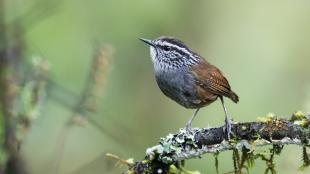
Gray-breasted Wood-Wren in Oaxaca, Mexico

Wood-Wrens - A Tropical Duet

Gray-breasted Wood-Wrens sing a duet. Each sings a different phrase, yet the phrases are so closely linked, it sounds like one song. Such singing is called antiphonal song. The pairs use song to stake out and hold breeding territories. Dueting is most typical of birds that live in dense…