
Image: The Ultimate Bird Drawing Throwdown Showdown Graphic featuring images of David Sibley and H. Jon Benjamin

Join BirdNote tomorrow, November 30th!

Illustrator David Sibley and actor H. Jon Benjamin will face off in the bird illustration battle of the century during BirdNote's Year-end Celebration and Auction!
RESERVE YOUR SPOT

Shows With Contributions by Bob Sundstrom

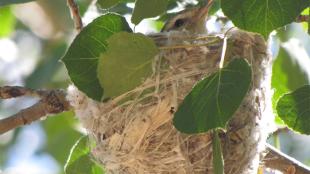
A Warbling Vireo sitting in its small nest that is attached to a slender branch.

Choosing Where to Nest

When it comes to building a house, one of the first decisions is where to put it. The same is true for birds. It's called "nest site selection." And one thing most birds have in common? The female chooses the site. A robin builds its nest on top of a stout branch. This Warbling Vireo hangs…
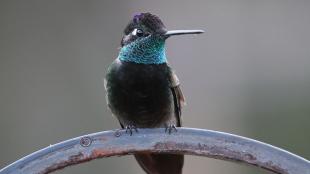
Rivoli's Hummingbird looking slightly to its left; the iridescent greenish blue color on its throat and some violet showing on its dark head

How Hummingbirds Got Their Sweet Tooth

All birds lack the typical gene for detecting sweetness, but hummingbirds avidly seek out sugary nectar. It turns out that evolution has transformed hummers’ taste receptors. Mutations to their savory taste receptor gene allowed the receptor to respond to sucrose and other sugars…
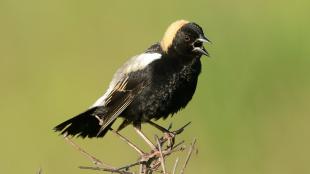
A male Bobolink singing in the sunshine

Bobolinks

Washington Irving called the Bobolink "the happiest bird of our spring...he rises and sinks with the breeze, pours forth a succession of rich tinkling notes ..." Bobolinks nest in hayfields and grasslands, returning north each spring, all the way from southern South America. Listen to more…
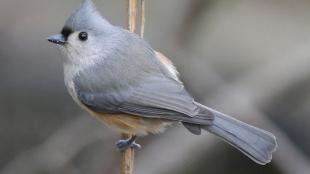
Tufted Titmouse showing its grey back and perky little crest. It's perched on a branch and looks ready for takeoff.

Tufted Titmouse - What's in a Name?

A Tufted Titmouse has just about everything you could ask for in a backyard bird. Petite and strikingly elegant, it’s as perky as a chickadee. In fact, it’s a cousin to the chickadee. And as it comes boldly to your seed or suet feeders, the Tufted Titmouse will even hang upside down like…
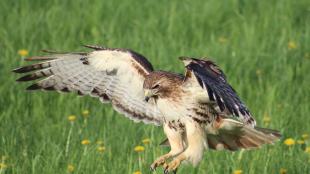
Red-tailed Hawk, wings raised as it lands on a grassy area

Red-Tailed Hawks - Adaptable Diners

Red-tailed Hawks are found year ‘round in a wide variety of natural landscapes, from meadows to forest edges, deserts, and canyons. One big reason we see Red-tailed Hawks in so many places is their remarkable adaptability as hunters. They vary their diet to what is locally abundant. So…
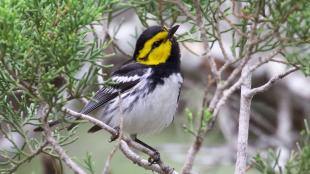
Golden-cheeked Warbler male

Endangered Species Day

This Golden-cheeked Warbler nests only in a Central Texas woodland. Its small breeding range is ever more fragmented by residential development, and its numbers are in serious decline. Endangered Species Day was established by Congress to acknowledge the plight of this warbler and many…
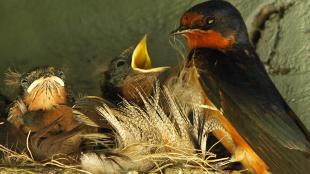
Barn Swallow at nest with hungry chicks. The Barn Swallow parent has a dark blue back and reddish-orange throat, and one Barn Swallow chick has its yellow beak open, while the other Barn Swallow chick has beak closed, showing the yellow "gape" around its beak.

Swallows Return to Nest

Each spring, eight species of swallows — including this Barn Swallow — migrate north from the tropics to nest in North America. Tree Swallows and Purple Martins are especially dependent on man-made nestboxes. Tree Swallows nest over much of the continent, while Purple Martins are most…
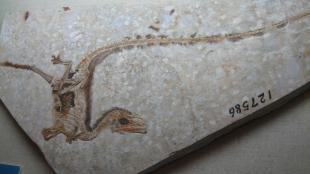
A Sinosauropteryx fossil photographed at the Henan Geological Museum, Zhengzhou, China. The body and long tail show traces of feathers preserved in the fossil.

China's Golden Age of Fossil Discovery

In the mid-1990s, a golden age of fossil discovery began in the Liaoning region of northeast China. The fossils date from 120 to 160 million years ago, when feathered dinosaurs and early birds were flourishing and differentiating. The signature fossil was the world’s first-known feathered…
A Great Bustard with his grey head and wispy beard contrasting with the brindled reddish brown and black wing, back, and tail feathers. The Great Bustard is standing amidst vivid greenery and his tail is turned up at a sharp angle.

Great Bustard

A Great Bustard shows off to a group of females by inflating special neck sacs – producing what sounds like a massive sneeze followed by a Bronx cheer. He flips his wings almost upside down to reveal bright white undersides, while fanning his tail and long, white throat whiskers. Three…
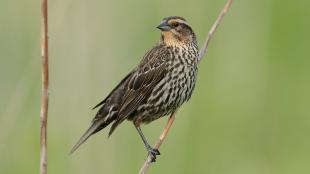
Female Red-winged Blackbird perched on a stem, her head turned toward her right shoulder

Female Blackbirds Choose Their Mates

One male Red-winged Blackbird’s marshland territory may include five—or even as many as fifteen—nesting females. And he makes an effort to mate with every one of them. Biologists call this polygyny - when one male claims breeding rights with multiple females. But while this may look like…