
Image: The Ultimate Bird Drawing Throwdown Showdown Graphic featuring images of David Sibley and H. Jon Benjamin

Join BirdNote tomorrow, November 30th!

Illustrator David Sibley and actor H. Jon Benjamin will face off in the bird illustration battle of the century during BirdNote's Year-end Celebration and Auction!
RESERVE YOUR SPOT

Shows With Contributions by Michael Stein

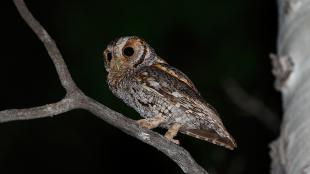
Flammulated Owl perched in tree at night

Flammulated Owl

The Flammulated Owl is a study in camouflaged grays and browns, with cinnamon-brown shoulder straps and large brown eyes. This astute aerial predator stands a little more than six and a half inches tall, from its sharp-clawed feet to its stubby, ear-like tufts. It winters in southern…
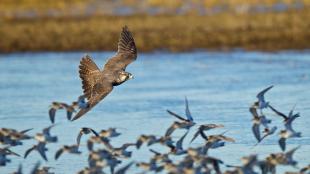
Peregrine Falcon attacking shorebirds, Samish Flats, Washington

Peregrine-Shorebird Interaction

Have you ever seen a Peregrine Falcon attack a flock of shorebirds, igniting a breathtaking aerial display? The late falcon researcher Steve Herman called this pattern of evasion "instantaneous synchronicity." The shorebird flock will often form a cone, with the sharpest point shifting…
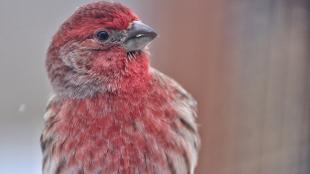
Male House Finch in close-up

Birds Have No External Ears

Unlike mammals, birds have no external ear structures. Their ear openings are hidden beneath feathers on the side of the head, just behind and slightly below the eyes. (It's easy to imagine where this House Finch's ear is, isn't it?) In mammals, the external ear structure helps funnel…
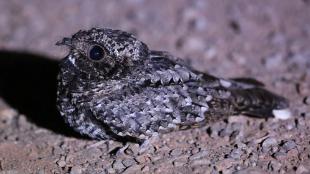
Common Poorwill, male

Poorwills at Night

Close kin to the Whip-poor-will, the nocturnal Common Poorwill can be heard in summer in the rocky scrublands of the West at the deep end of dusk. And the Common Poorwill's greatest claim to fame? It was the first bird confirmed to hibernate, based on evidence verified in 1946. Since then…
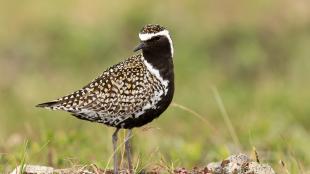
Pacific Golden-Plover

A Plover's Journey

Pacific Golden-Plovers, known as Kolea, winter in grassy, open areas of the Hawaiian islands by the tens of thousands. The birds return each fall to the same patch. Kolea spend nine months in Hawaii, but by late April, they form large flocks and head north, over the Pacific Ocean to, as…
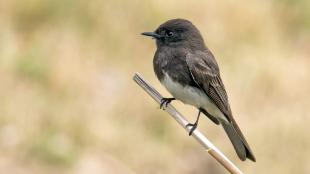
Black Phoebe by Mick Thompson

Two Phoebes Share the West

In the American West, there are two species of phoebe that share the same expansive country. But they occupy different habitats. The Say’s Phoebe prefers dry, open country ranging from tundra to desert. This Black Phoebe is a close cousin to the Say’s. But it is nearly always hunting…
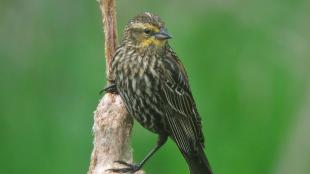
Female Red-winged Blackbird

Birdwatching 104 - A Summary

How do birdwatchers identify one species from another? First, they look carefully at the bird. What's the overall color? Is its bill long or short, thin or stout? What about its markings -- a ring around its eye or stripe on its head? What's your bird doing? Bird behavior can help you sort…
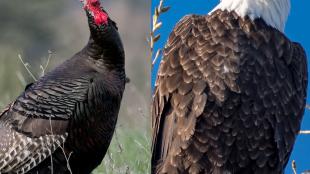
Wild Turkey and Bald Eagle

National Symbol - Turkey vs. Eagle

As an old tale goes, after the eagle was chosen for national emblem, Benjamin Franklin questioned the choice. In a letter to his daughter regarding a medal created by the Society of the Cincinnati, he wrote wrily: "The Bald Eagle is too lazy to fish for himself; when the Osprey has taken a…
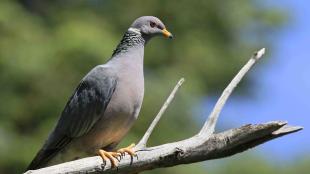
Band-tailed Pigeon

Band-tail, Pigeon of the Woods

Band-tailed Pigeons are found mostly in low-altitude forests. Though about the size of city pigeons, they can be shy and sometimes hard to see. Strictly a bird of the western states, the Band-tailed Pigeon is decreasing in numbers. This is probably because the forests that the pigeons…
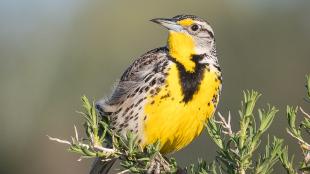
Western Meadowlark

Two Meadowlarks and a Poem

In his poem “Trying to Fall Asleep in South Dakota,” poet Tom Gannon wrote about meadowlarks. He might have been hearing a Western Meadowlark, which nests across South Dakota in the summer. But if he’d been in the south-central part of the state, it might have been an Eastern Meadowlark…