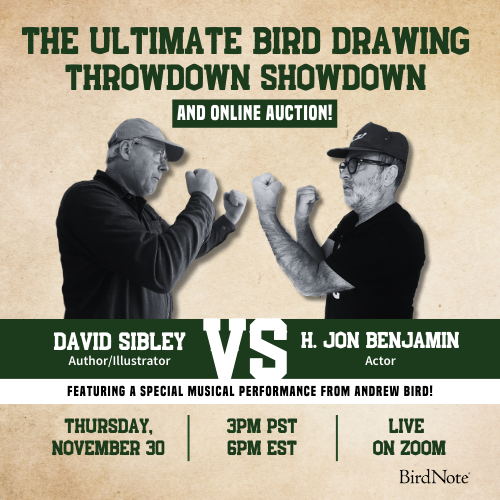
Join BirdNote tomorrow, November 30th!
Illustrator David Sibley and actor H. Jon Benjamin will face off in the bird illustration battle of the century during BirdNote's Year-end Celebration and Auction!
Celluloid Birding with Christian Cooper
Bring Birds Back Season 8, Episode 6: Let’s talk about birds in film and television!

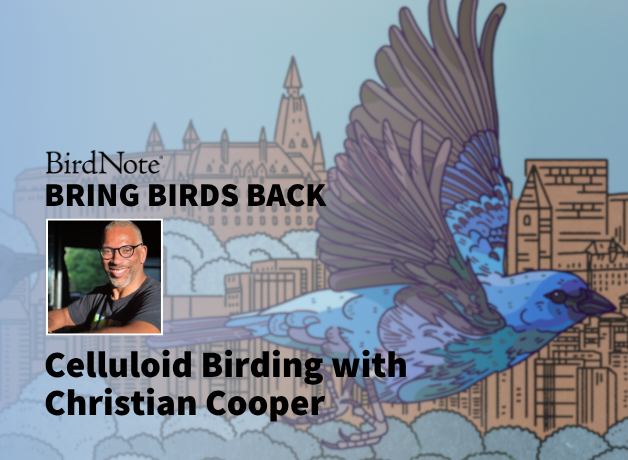
In this season 8 finale, Dr. Deja Perkins chats with Marvel writer, Emmy-award winning host, and famed author and birder, Christian Cooper! In this hilariously entertaining and highly-educating talk about the latest birding boom in Hollywood, Christian shares so many gems. Like his most favorite and least favorite bird appearances in film and television, and his very own work in media from National Geographic to his Marvel comic book. Plus, there’s a trivia game for you to join – and you don’t want to miss it! Available now.
BirdNote is a nonprofit. Your tax-deductible gift makes these shows possible.
Want more Bring Birds Back? Follow us on your favorite podcast app and on Instagram @BringBirdsBack! For more about BirdNote, sign up for our weekly newsletter. And for ad-free listening and other perks, sign up for BirdNote+ here.
Learn how you can get involved in our From Love to Action campaign when you visit this page!
Bring Birds Back Season 8 is sponsored by Teton Science Schools and the Cornell Lab of Ornithology’s Bird Academy.
[Bring Birds Back Stinger]
Deja Perkins: BirdNote Presents.
[intro music starts]
This is Bring Birds Back and I’m Dr. Deja Perkins.
People love birds. Birds have been prominent in popular culture for centuries, from writers like William Shakespeare and Edgar Allan Poe to animated childhood stories, like Daffy Duck, or Woody Woodpecker, even the Penguins of Madagascar. And since the start of the pandemic, we’ve seen even more ways that birds are taking over modern media.
To help me walk through this birdy evolution on the screen, in media and pop culture, I’m talking with Emmy-winning National Geographic host, New York Times best-selling author, Marvel comic book writer, and world traveler who’s spreading the gospel of birding, near and far: Christian Cooper.
Deja: Hi, Christian. Thank you so much for joining me and talking with me today.
Christian: Sure. I like to talk about birds. I like to spread the gospel of birding, as I like to say.
Deja: Yeah. I'm really glad that our listeners will get to learn a little bit more about you today, you've done so many really cool projects. I am curious about your connection between media and birds. I know you grew up as a comic book lover and became a pioneer comic book writer, even. And I'd say comic books and birding are two somewhat niche hobbies. How did they come about for you? Were they connected at all?
Christian: Are you calling me a nerd?
Deja: [Laughs] Well, I'm also a nerd, so nerds unite.
Christian: No, it is entirely accurate. 'Cause I started birding when I was like nine or 10 years old. By the time you're at junior high or high school and you're a birder, people are looking at you sideways to begin with, and then you're into science fiction and comic books and all this other stuff? Forget it. I was branded. I might as well have walked around with a scarlet letter planted across my forehead.
Birding is having this big renaissance...
Um, they are very niche; both comic books and birding are very visual, which is an interesting commonality between them. But they are also conquering the world, simultaneously, as it turns out. Look at the success, for example, of the Marvel Cinematic Universe. I was lucky enough to go on and work at Marvel for a while, which was like the dream job, which I didn't get to do the "dream job" again until I was doing the birding TV show. But the Marvel cinematic universe everybody knows about it, everybody sees those movies. And then birding is having this big renaissance, you know, largely after the COVID pandemic when people were on lockdown and it just made birding boom. Amongst other things, you know, a lot of us have been, like, trying to get people birding from various walks of life and, I don't know, I think we've caught a little fire, we're in the zeitgeist. We show up in the media all the time now.
Deja: Yes. And I, I think “renaissance” is a really great way to put it. 'Cause there really was this explosion. And so I'm curious, were there any comic books that influenced your love for birding or vice versa when you were growing up? I know you talked a little bit about Marvel. Was there something specific?
Christian: No, and it's funny because there's a character in Marvel comics called “The Falcon”. He's a Black superhero, and so you know, he's Black, he's bird-themed, and people are always like, 'Oh, you must really love The Falcon'. And I can't stand The Falcon because, to me, he's like the epitome of negro sidekick syndrome, you know? Cause he was Captain America's sidekick, and I'm like, ‘no, no, I don't wanna be a sidekick,’ you know? We should be up front like everybody else. Plus, his powers were kind of lame, so I was never a big Falcon fan.
Deja: That's so funny. And I feel like we could go into the transition in the film, how the Falcon kind of turned into Captain America, but we won't go there 'cause I'm sure that'll be very long–
Christian: That would be a long conversation, but I can tell you somebody who I am a fan of...
Deja: Sure.
Christian: …which is a DC character called Raven.
Deja: Mmmm.
Christian: And she dresses in all black and her hood kind of makes this long beak in front of her. And I just always loved her 'cause she's such an unusual superhero. You know, most run around in tights and use their strength and whatever. And Raven, she's a female character, she's dressed in a gown and a cloak, and her powers are all sort of weird; sending out her shadow self to do things and sensing emotions. And I just thought, 'She's just too cool. Plus she's named for a great bird.' So yeah, Raven is definitely one of my favorite characters.
Deja: I love that character as well and I think about the real life adaptation in that HBO series and how ravens were seen as these dark and almost like villainous birds, thinking a lot about Edgar Allen Poe and his poetry. And because she had this darkness inside of her, she was also seen as this potentially villainous character. But in the end, she turns out to be this superhero and using her powers for healing and all these great things and end up saving the world. And, you know, ravens have this role within the ecosystem as well that's very important. Even though sometimes they're portrayed as this evil kind of villainous bird, um, black bird specifically.
Christian: They are probably, arguably, the smartest of all birds. I've heard them referred to as chimpanzee-smart. And technically, they're a songbird and they are the biggest one there is. They are just cool on so many levels. I just absolutely love ravens.
Deja: The first time I saw a raven I was out west, in Arizona and I'll never mix up a crow and a raven ever again just because of how large they are, the sheer size of them. It's just once you see it, you'll never forget it.
[Playful inquisitive music starts]
So, I know you have this series on instagram called the Celluloid Birder. What sparked your interest in cinema and more specifically, birds in film? And then how did that lead into this series?
Christian: Okay, so just a minor qualification: on my Instagram, @ChristianCooperBirder...
Deja: Mm-hmm.
I will do what I call the Celluloid Birder, which is the connection between birds and television and film.
Christian: …Every once in a while, I will do what I call the Celluloid Birder, which is the connection between birds and television and film. So how did that come about in my sort of consciousness? Because, when you're a birder, it never turns off. I, I mean, as you know, you know, you're walking down the street and you're having a conversation with someone, and suddenly your head shoots up, and you go, 'oh, there's an American Kestrel here'. 'Cause you heard a klee-klee-klee-klee-klee, you know, in the middle of the conversation. And despite all the traffic noise and everything else, that sound just cut right through. Well, the same thing happens when you're at the movies. So you're sitting there and you're like, 'Oh it'll be fun to watch this movie'. And you're like, 'oh God, they got the birds wrong'. And the rest of the time you're like thumping on the armrest of your chair in anger and rage.
It's really funny 'cause it happened to me just the other day. Because I'm a nerd, I go to a 24 hour science fiction movie marathon in Boston every year. So I sit in a movie theater for 24 hours watching continuous science fiction movies with a bunch of other nerds. Yeah, I know. It's crazy. I still do it. I've been doing it for, God, 40 years now.
Anyway, I'm sitting there, I'm watching “Attack of the 50 Foot Woman,” some old B-movie, you know, stupid science fiction thing, in black and white.
[clip from Attack of the 50 Foot Woman]
And you know, I'm not paying much attention. But then all of a sudden, I'm like zero-focused, laser focused; because I notice in the background, the woman who will become the 50-foot-woman is in her living room boozing it up because she's just had another fight with her no-good husband. But in the background on the wall is a portrait of birds, a painting of birds, and I'm like, those are egrets. Can I identify those egrets? Let's see. And then I spent the next 10 minutes waiting for her to move to the side so I could see. And sure enough, the egrets had yellow feet and I'm like, Snowy Egrets. Got it. Nailed it.
[Snowy Egret call]
So, you know, it's, it's just fun.
[Snowy Egret call]
You know, on podcasts, we talk a lot about the dire stuff that's happening. You know, the loss of the species. Uh, in my lifetime, we've lost a third of North American birds, just in the time since I've been birding. You know, we talk about the regulations and the rollbacks. There's just so much awful stuff right now. But this is just fun.
This is just a way to enjoy birds in a setting where you would never think you would be able to enjoy birds, and yet it pops up all the time.
[Music ends]
Deja: Part of what I gained from what you said was that birds are kind of this distraction in real life and in the movies. They don't even know that they're giving themselves away in these productions because it doesn't seem to be intentional sometimes, to have this kind of input of birds. But they're giving us something else to look forward to in film and media as well.
Just as birding adds a whole new dimension to everything you do in life, it can add a whole new dimension to everything you do in entertainment...
Christian: Well, just as birding adds a whole new dimension to everything you do in life, it can add a whole new dimension to everything you do in entertainment.
Deja: Absolutely.
Christian: (Laughs)
Deja: Let's talk a little bit about the evolution of birding and birders in films and media. Previously for me, anytime someone learned that I was a birder, they would ask if I had seen “The Big Year.” And that was like the birding movie everyone told me to watch. Um, but now they ask me have I seen “The Residence”? And so what shifts have you been noticing since you first began with birds and birding in film?
Christian: Well, 'cause I'm a little bit older than you are, one of the things I've noticed is that people used to ask me, “Oh, what did you think of ‘The Birds’?” You know, the old Alfred Hitchcock horror film where the birds just go crazy and start attacking people?
[short clip from “The Birds”]
I've met a few people who have a fear of birds because of that movie. So that's what I used to get. Then of course it became “The Big Year”. And as you said, “The Residence.” I mean, “The Residence” took us to a whole new level. That was just awesome. And this is why I say we're having a renaissance, not just in actual birding, but in birding depictions in entertainment.
There's a miniseries called “Task” that's streamable on HBO. And the lead FBI investigator, played by Mark Ruffalo, is a birder and they establish it at the very beginning. And in fact, they have a scene where he's sitting on his porch and he hears a bird. So he pulls out his phone, he turns on Merlin [Bird ID app], and Merlin tells him what the bird is and they got all of it right. You know, they show a Summer Tanager and his phone says Summer Tanger and he's like, 'oh, oh wow, that's rare for this area.' Which, because he's in Pennsylvania, it is actually pretty, not unheard of, but relatively rare for that area. So they got all of it right. The only thing they got kind of wrong was that he uses his binoculars with one hand, which like nobody really does 'cause you'd be shaking around too much.
Deja: Yeah.
Christian: A big one that's fairly recent in like the last month and very close to my heart - 'cause again, I'm a nerd, I'm a Star Trek fan; I actually wrote a Star Trek comic when I was at Marvel and the Star Trek comic I wrote was called “Star Fleet Academy.” Well, they now have a TV series, different story but with the same name and they have a Klingon. And for those who don't know “Star Trek,” Klingons used to be the bad guys. Now they're our friends but they're this honorable warrior race. And so they have this Klingon cadet at Star Fleet Academy and at one point somebody hands something back to him that was stolen from him and it's binoculars. And he says, 'I watch birds' in that very Klingon terse way. And I was like, 'no way, no way, yes!' So even the Klingons in the 32nd century now watch birds.
Deja: Wow, that's a really large evolution, just kind of through history and how we're even projecting it across genres and into the future in Star Trek as well, which is pretty cool. You bring up one really important point and that's thinking about accuracy versus pure representation in film and media. How, in some films, birds can be made to seem scary and how that influenced people to maybe be afraid of birds. And growing up in Chicago that's definitely something that a lot of folks seemed to be afraid of: birds attacking them or pooping on them and all of those things, at least people that I had come across as a kid.
And so, thinking about "Jaws" and sharks, the way that nature and animals can be represented in film, can actually make or break what the public thinks about the said topic. So how important is accuracy versus just pure representation in film and media, is it better for us to just have them somewhere in the film, or is it important that it's actually accurate in its depiction of not just the birds themselves, but in birders as well?
I will always argue for more accuracy. It’s hard not to, but even when it's inaccurate, it's kind of an entry point for conversation
Christian: Well, I will always argue for more accuracy. It’s hard not to, but even when it's inaccurate, it's kind of an entry point for conversation. You can talk to people about why this wasn't right or what this means, or why, maybe, this is not what we need to focus on about the birds. The only caveat I would add to that is sometimes representation can be a bad thing. And what I'm thinking of - and this is going way back before you were born - there was a TV show called, "Baretta” and the lead character was like some police investigator. But the big gimmick was that he had a pet bird, and it was a Sulphur-crested Cockatoo. And because this bird suddenly got all this media exposure, all these people started flooding the pet trade, wanting Sulphur-crested Cockatoos, which was not good for the species. And so, you know, that's the kind of representation you don't want when it triggers a sort of exploitative, negative result in the world. But by and large, I think any sort of representation, even if it's a little dodgy, can be good, 'cause it can start those conversations.
Deja: And I'll follow up with a more recent example of the flip side of that. I think about "Rio,” the movie about the lady who found the blue macaw on the street and she took it in as a pet and they were going extinct. And so a scientist came over, and he wanted to get her macaw to mate with this other macaw to reestablish their population.
And I feel like that movie went into how the pet trade can be negative on natural populations. And I thought from my younger, younger self, it is important. Like it, it brings about a conservation theme in this movie. And so that's kind of like the flip side of the example that you were giving.
Christian: Now, so you're talking about the animated film, "Rio"?
Deja: Yes, the animated film, "Rio".
[Both laugh]
Christian: Uh-huh. How, how, how old were you when that came out?
Deja: I don't know, I don't know what year it came out. [Laughs]
Christian: Mm-hmm.
Deja: But it's something that I still watch a lot. Hey, I love animated films, so we'll call me child at heart.
Alright, so we talked a little about some examples of which ones don't do it too well and have kind of like a negative representations, but can you--
Christian: Oh, we have barely scratched the surface, we have so much to talk about, but go on.
Deja: Well, let's dive deeper then. Can you give us some more examples of what shows do it right and which ones just completely missed the mark?
[music starts]
Christian: Okay, good. Um, let's talk about some current examples for, like, people who wanna go to the movies tomorrow. You could go see, "H is for Hawk,” which is a movie adaptation of a very famous memoir about this woman whose father dies and she and the father were both involved in falconry. And so she gets over the grief by working with this goshawk. So they made a movie out of it. They got the right bird; they used a goshawk. In fact, they used multiple goshawks, as they usually do in movies with animals, you know, they've gotta have more than one. Only problem? They used goshawks in two distinctly different plumages.
Deja: Mm.
Christian: So from scene to scene, the bird is changing from an adult plumage goshawk, which is kind of slatey blue-gray to a juvenile goshawk, which is streaky and brown. And I'm like, this bird is going from young to old, to young to old, to young to old, from scene to scene. And I was sitting there, of course, like I said, pounding the armrest on my chair in the theater. So they got it wrong.
Um, another movie that got it wrong is "Hamnet". Nominated for an Academy Award, so it's a big deal, and it's based on the life of Shakespeare and his wife and their children, and also dealing a lot with grief. But, at the very beginning, the woman who will become Shakespeare's wife has a falconry bird and it's a Harris's Hawk. The only problem is that the Harris's Hawk is a bird of the desert southwest of North America, and they wouldn't have had them as falconry birds in Shakespeare's England.
Some places get it wrong for various reasons...
So, you know, some places get it wrong for various reasons. One that gets it right, if anybody is watching TV these days, there's a TV show called "Heated Rivalry” that's on HBO. It exploded. It took off. It's about these two closeted gay hockey players who hook up and what happens.
Well, they have an episode that's set on a lakefront cottage in Canada, and they have this entire scene that revolves around the call of a loon and they got it right. And not only that, but in all the daytime scenes, when they're at the cottage, all the bird songs you will hear in the background are all correct, and they really did a pretty amazing job.
And what I like about that is that I learned something; and that is something that'll happen frequently; if you start paying attention to the birds in media, you'll learn stuff too. Like, I thought- because the Russian hockey player is shocked at the sound of a loon and he calls it a "stupid Canadian wolf bird". 'Cause he thinks it sounds like a wolf. And I'm like, well, a Russian wouldn't be shocked by that. They have common loons in Russia. And I looked up the range of the Common Loon, and they are in Europe, a little bit in Western Europe, but they're not in Russia. So I learned something. So yeah, some places get it right, some places get it wrong, but you can always learn something in the process and that's part of the fun.
Deja: Oh, absolutely. It sounds like - based on all the movies and TV shows that got it wrong - that maybe they need to start hiring some birding consultants on their sets.
[music ends]
Christian: Well, a very well known birder named Kenn Kaufman, which I'm sure a lot of your listeners know Kenn Kaufman, he was actually the consultant on “The Residence,” which is why they got so much right on that show. And it's funny, even if you're a birding expert or a birding consultant, you've still gotta be careful.
And I'm thinking of some examples like, there is a stupid Mel Gibson movie called "Apocalypto," set in, uh, pre-Columbian times in Mesoamerica.
And so they show a river and they show a cattle egret at the river. And I'm like, 'nope, no good'. A lot of people would say, 'no, there are cattle egrets in Mesoamerica'. And that's correct, there are cattle egrets in Mesoamerica, now. But in pre-Columbian times, there were not, the cattle egret didn't hit the Americas until I think the late 1800s, early 1900s. And so to have a cattle egret in pre-Columbian times, it wouldn't happen.
...For me that's a perfect metaphor of the African diaspora experience...
And I will quickly add that cattle egret is one of my favorite birds. 'Cause to me it is the perfect example of the African diaspora because they are an African bird. That's why it's wrong to have Western Cattle Egrets in, in the Americas so early. They got blown off course and ended up in the Americas. And ended up thriving here. And for me that's a perfect metaphor of the African diaspora experience; that we people of African descent got dragged across the ocean by no fault of our own. And yet here we are and we found a way to thrive and live here and make our way here just like the cattle egret. So to me, the cattle egret is the- the spirit of Black lives set loose into the air. So I, I just love the cattle egret.
[Lofi music starts]
After these messages, Christian talks about his own work from comic books to television, and gives us some tips for diversifying your birding experience at home. Plus– a fun trivia game you won’t want to miss… All that and more, coming up!
MIDROLL
[Intro music starts]
Deja: Welcome back! I’m Dr. Deja Perkins and we’re continuing our chat with author, writer, host, and birder - Christian Cooper. We’ve discussed his personal entry into birding and media, as well as Hollywood’s more recent birding boom. But we can’t forget that Christian is a writer and creator himself. From his nature-based tv show to his very own Marvel comic book:
[Music ends]
Deja: I really love the connections that you make between birds and the Black diaspora. You wrote A semi autobiographical digital comic book called "It's a Bird," and in that book, your lead character Jules is a young Black teenager and bird watcher who sees the faces of Black individuals killed by police through the binoculars gifted to him by his grandfather. It aligns very particular birds with these individuals like the Scarlet Tanager for Amadou Diallo?
Christian: That's correct. Yep.
Deja: Um, and then an Eastern Bluebird for Breonna Taylor and a yellow warbler for George Floyd. What inspired you to use birds in this way?
Christian: (Exhale) I am a fan of magical realism, and magical realism is a literary tradition coming out of Latin America. And it is a way to have totally impossible fantastical things happen in everyday life and it's just considered normal. And it's a way of expressing how the reality one lives is so difficult, so extreme, so radical in some respects that the only way to accurately communicate how it feels, is to have these fantastical, radical things happening that nobody bats an eyelash at, because it's just part of the context.
So, I was actually approached by friends of mine at DC Comics about doing a comic book based on my experience in Central Park when I, you know, had a racial incident there. And I was like, DC Comics? Superman, Wonder Woman, Batman? You know, how do you put a story like that into a superhero context? You can't. And then they said, ‘You don't have a story yet, but we have a title: "It's A Bird,’" which of course is a play on Superman; you know, "look up in the sky, it's a bird, it's a plane, it's Superman."
[Clip from "Superman" intro]
And as soon as they told me the title, the story just populated in my brain.
And as soon as they told me the title, the story just populated in my brain. I realized that it was not a superhero story that I needed to tell. It was a magical realist story I needed to tell. So that's how I ended up having these mystical, magical binoculars that have been handed down through the generations of this Black family end up in Jules's hands.
And they open his eyes in more ways than one. And as far as the choice of the birds, it's very interesting because, one of the things that happened in the aftermath of that incident and while the pandemic was still in full swing, was that a lot of the stores were closed and boarded up. And people put graffiti on the boards; Beautiful graffiti, really great artwork. And one of them was a picture that said, "Birding while Black is not a crime." It wasn't exactly that, but it was close. And the pictures it had were of a Yellow Warbler, a Scarlet Tanger, and an Eastern Bluebird, and that's why I picked those birds to be used in the comic book.
[slow to mid-tempo music]
Deja: Wow, the way you tell that story was really able to help me visualize it. And maybe one day they'll take that and turn it into a mini animated series.
Christian: Wow. That would be heavy because it's a heavy story.
Deja: It would be heavy. But I also think it- it's a good way to kind of talk about things that our grandparents, our great-grandparents, they've gone through in this country. And even the birds they may have seen and the birds they may have heard and the stories that could be passed down that they would've seen through these binoculars. So, I don't know, sometimes we need a little animation in order to help.
Christian: Well, I'll tell you another point where exactly what you're talking about happened, but I think in the whole theater, I was the only one who experienced it. And this will bring us back to television and film. There's a movie that came out in 2013, really great movie called "12 Years A Slave". Um, did you see it?
Deja: I saw it in theaters, um, on a school field trip, and I have not been able to rewatch it since.
...The sound of a Blackburnian Warbler encompasses everything that's wonderful about the world.
Christian: I have not been able to rewatch it since either. So prepare yourself before you see this movie, but it is an amazing movie. It's by a director called Steve McQueen. And what he did was juxtapose the beauty and the magnificence of the natural surroundings of the southern environment, with the horrors, unvarnished, of slavery. It's a very powerful movie.
So at the climax of the film, there's an awful situation that I won't describe, but it's emotionally horrifying. And so I am sitting in the theater experiencing this emotionally horrifying moment. And in the background I'm hearing a Blackburnian Warbler. The Blackburnian Warbler is my favorite warbler. And to me, the sound of a Blackburnian Warbler encompasses everything that's wonderful about the world.
I hear that song and it, to me, it's just all the joy of the world poured into one voice. And here I am hearing that song of all things juxtaposed against this horrifying moment. And I sat there in the seat. I, I don't cry easily, but I started to weep in, in the theater because it, it was exactly what the movie was about, juxtaposing those things. And yet I know nobody else in that theater was hearing what I was hearing or feeling what I was feeling at that moment. And I've gone back not to the movie, 'cause like I said, I haven't watched the whole movie again since. But I've found that scene online and I've played it through really good speakers. Just to make sure I was hearing what I thought I heard. And I am 95% certain that that's a Blackburnian Warbler singing in the background. And if you don't know the Blackburnian Warbler song, it's very high, very thin, almost beyond human hearing. But the last note slides impossibly high, with an urgency that sounds like the bird is being strangled. So at that moment, to hear that strangled cry as that awful thing is happening on screen, it just broke me.
Deja: To be able to make those two connections, it- it makes me wonder if maybe, someone on the production team was actually a birder and intentionally put that in there.
Christian: I, I actually wrote to the production team to ask, but you know, I don’t know if I wrote to the right people and I never heard back. So if you're listening, let us know.
Deja: Definitely.
[Music ends]
Christian: Um, well, I would be remiss if I didn't mention the worst of the worst in terms of birds in film and television.
Deja: I think I might know what you're, what, what you're gonna pick on, but I wanna hear you say it.
Christian: [Laughs] I mentioned it in my memoir. Um, and it is a movie called "Blood Diamond" from 2006, starring Leonardo DiCaprio and Djimon Hounsou. What is so offensive about this movie? Well, if you're not a birder by ear, you won't notice. And that's important to note because a lot of times, when we are talking about birds in television and film, we're talking about the sounds. 'Cause that's most often what you get. Like, you know, the infamous, infamous Bald Eagle that screams Red-tailed Hawk every single time…
[Red-tailed Hawk call]
... because they just don't think the real Bald Eagle's call sounds butch enough.
[Bald Eagle call]
But, if you are listening, as you're watching Blood Diamond - which is set in Africa - every single bird song is North American and it drives you crazy. I mean, I have never heard so many Black-throated Green Warblers in my life as there were in that movie! And I'm like, wait, was there like a flight of them that got blown across the Atlantic and they landed in Africa? Like, from the opening frames, I think you hear a Blue Jay calling. So yeah, that is the absolute worst of the worst.
Now, one of the best is, "I am Legend". It's a science fiction movie from 2007, starring Will Smith. And in it, you know, basically human beings are gone, so Will Smith is like the last man on Earth. And so all our places are kind of gone back to nature and it's set in New York City. And I'm sitting there and I'm hearing, for example, an Eastern Phoebe calling from Union Square right in the middle of downtown Manhattan. I'm like, you know, that's exactly what would happen. If people were gone and wildlife started to recolonize Manhattan, there would absolutely be an Eastern Phoebe in the middle of downtown Manhattan. So, uh, I mean, we get Eastern Phoebe's in migration in Manhattan, anyway. So yeah, there are movies that get it right and movies that get it wrong, and it's- it's just fun to keep track of them.
Deja: It's great when they get it right and distracting, very distracting when they get it wrong.
[Jeopardy-style game song]
Alright, it’s time for us to play a little trivia! If you’re a longtime Bring Birds Back listener, you may be familiar with Bird Association, our-bird-based game! Of course, I’ll be asking Christian these questions but YOU, yes YOU, can play along with us, too! First, I’m going to name a film or tv show and describe a scene from it that includes an appearance or mention of a bird. Then, I’ll ask a specific question about that scene for the answer. Listeners, you have 5 seconds before we reveal the answer. Alright, got it?
Christian: Absolutely.
Deja: Alright, so first we're gonna start with “The Residence,” which is the 2025 Netflix series. And in episode two, Cordelia says, "If you look up what a [blank bird] ends up killing, you will almost always discover something like this: Slightly damaged wing, broken leg, the inexperience of youth and familiarity with this terrain. There will be something. They'll pick a single bird out of a flock of thousands. The odd one, the weak one, they'll find them." What bird is she referring to?
[5 second pause / jeopardy-style ticking clock]
Christian: I think she's referring to a falcon. Do I have to be more specific?
Deja: No, you are correct. It is a falcon.
[Peregrine Falcon call]
Christian: Ok, phew, whew! [Sigh of relief]
Deja: Yeah, that's definitely thought about a bird eating bird, for sure.
Christian: And I've seen “The Residence,” so I should have been able to rattle that off the top of my head, but I had to think about it. Okay.
Deja: But you got it right.
Christian: Yay.
Deja: Okay, so next up: we have “The Big Year,” which was the 2011 movie with Steve Martin and Jack Black. And in “The Big Year,” we see both a Pink-footed Goose bathing in an alpine hot spring, and a molting American Goldfinch with brownish olive plumage in the middle of the summer. Which of these were wrong? Between the Pink-footed Goose and the molting American Goldfinch?
[5 second pause / jeopardy-style ticking clock]
Christian: I am gonna go with the molting American Gold Finch.
Deja: You are 50% right! Uh, so both, it was the wrong habitat for the goose and the wrong season for the goldfinch.
Christian: Okay. Shows what I don't know about Pink-footed Geese.
Deja: Right. Me neither. So next, we'll talk about Shawshank Redemption, the 1997 movie.
Christian: Great movie.
Deja: In this scene, Red, played by Morgan Freeman, hitchhikes from a halfway house he's staying in while on parole in the state of Maine. He ventures to a big farm field in search of something his escaped friend told him to find. On this trek in the middle of nowhere, surrounded by cars on a two lane rural road, he hears the song of a Cactus Wren.
[Cactus Wren song]
Is this an accurate location of a Cactus Wren?
[5 second pause / jeopardy-style ticking clock]
Christian: No, absolutely not!
Deja: You are correct. So, um, Cactus Wren are non-migratory birds found exclusively in the arid deserts and scrublands of the southwestern United States. So Arizona, California, Nevada, Texas, Utah, New Mexico and Mexico.
Christian: Now, what they could have put was a Carolina Wren, which also has a very booming, distinctive voice.
Deja: They're one of my favorites. All right. Um, so lastly, we have Cold Mountain, the 2003 movie. In Cold Mountain, the movie is set in North Carolina during the Civil War. In the dead of winter, the main character Inman, played by Jude Law, is walking home during a snowstorm through mountainous forests. In the quietest moment, you suddenly hear the song of a Red-eyed Vireo. Was this depiction factually possible or did they get it wrong?
[5 second pause / jeopardy-style ticking clock]
Christian: I am stretching my imagination to try to think of a Red-eyed Vireo somehow being in the frigid cold of the Carolinas. And, uh, my imagination does not stretch that far, so I will say no.
Deja: You would be correct. Um, because these long distance migrating birds spend their winter seasons in the Amazon basin of South America. So if anybody listening is from North Carolina, you probably got that one right.
Christian: All right. I'm- I'm gonna flip it on you now, Deja.
Deja: Oh, no. Okay.
Christian: So in the 1994 movie adaptation of Little Women starring Winona Rider…
Deja: Okay.
Christian: The movie is set in Massachusetts, I think the 1800s…
Deja: Okay.
Christian: At one point there's an outdoor scene and there's a Northern Cardinal singing, is this correct?
Deja: In Massachusetts, what was the time of year?
Christian: I think it was a winter scene.
[5 second pause / jeopardy-style ticking clock]
Deja: I, I'm going to say yes because the Northern Cardinal is one of the most widespread birds that we have in the US and hope that I got it right.
Christian: [Laughs] It was a little bit of a trick question because it is one of our most widespread birds in the US, today. But it is a bird that has expanded its range over time, further and further north.
In fact, in the 1920s, seeing a Northern Cardinal in New York would've been extremely rare. So seeing a Northern Cardinal in Massachusetts in the 1800s? [mimics buzzer] Not gonna happen.
Deja: Oh, well I should have known you were setting me up from that “Apocalypto” question. [Both laugh] Um, but no, that's really great to, to think about. Especially kind of wrapping in climate change and other science and how ranges are expanding and moving for a lot of these birds. Um, so that was really fun. Thank you for that.
[Music ends]
Deja: So, so far we've talked a lot about who does it right, who does it wrong, the explosion of birds in the media, and as the former host of Extraordinary Birder with Christian Cooper from National Geographic, you definitely played a large role in bringing a lot of that representation to the screen as well, specifically for Black bird watchers. What was your personal goal for your series? Like was it important to you to showcase not just birds, birding, but also yourself as a Black birder as well in this series?
Christian: I don't know if that was as much a goal, as a wonderful side effect. It's like, okay, if they're gonna give me a birding show, that means that the head of this first on a major network, at least in a while, is gonna be Black-- and oh, yay! Because, as we've discussed many times, there's a deficit in the African American community of birders, far less than there should be if we were just talking averages across populations. And that's something we need to fix.
Why do we need to fix it? Because if we don't have a diversity of birders, people who appreciate the birds, we're not gonna have the constituencies to protect the birds going forward, as this country becomes more and more diverse. Because, regardless of anything anybody wants or says or does, this country is becoming more diverse. And so we need to get everybody involved.
...If that meant that, you know, some little kid watching would think, 'oh, Black people do that?' and then went out and did it themselves? Mission accomplished.
So, I was very happy to be the face of this birding show because if that meant that, you know, some little kid watching would think, 'oh, Black people do that?' and then went out and did it themselves? Mission accomplished. We had a wonderful diversity of birders from every walk of life and of every kind. We had straight people, gay people, white people, Latino people, Black people. And that natural diversity of young and old, of gender is what birding should be and is what our country is and is what birding hopefully is becoming.
And I wanna add class too, because binoculars are expensive and they are a big barrier to entry to birding. But you know what? You don't have to have binoculars to bird. You can bird with your naked eye. And there are libraries and boys and girls clubs that loan out binoculars. I have never bought a pair of binoculars in my life. Every single pair has been either gifts or hand-me-downs. So, I don't want anybody to think, I'm not wealthy enough. I can't travel to Costa Rica to go see the--' No! You can bird, uh, in your backyard. Birds are everywhere. Um, so don't let the idea of class stop you.
And one of the things I love, I love this story. [In] our Central Park birding community, we had birding at the same time: the CEO of Goldman Sachs, who was one of the richest men in the world, and a woman who was homeless. And she had seen all of us birders in the ramble, and she's like, "what's this about?" And someone gave her their old pair of binoculars and she's out there birding just like the rest of us. And nobody bats an eyelash. Nobody cares. Nobody gives a damn that you're super rich, you're super poor. I didn't even know the super rich guy was super rich. He was just one of the birders. (And then later on, I found out what he did.) So every axis of diversity, we should all be out there birding. I don't care what it is.
You know, disability, that's a big one that we're working on now, making places accessible to more and more people. That's why we now try to avoid saying “bird walks” and say “bird outings” so that we're more inclusive. Everybody should be out there birding, no excuses. And when you're not birding, you should be watching television or film and birding. You know, watch the shows with your Merlin on and see what your Merlin tells you.
Deja: No, absolutely. I think that's a great suggestion and hey, that's one way that it can be more accessible. If you can't actually go outside, maybe just try and see what birds you're picking up and listening to on your favorite show or movie, or even check out any of the movies or TV shows that we've mentioned in this episode, so far.
Before we close out the episode, I'm wondering, what do you hope to see in the future at this intersection of birds, birding and birders in film and media? Are there any specific birds that you'd like to see represented on screen?
Christian: Hmm. Specific birds I'd like to see represented on screen? Hmm. Wow, that's an interesting question I've not thought about. Um, you know what I'm gonna go with an old favorite. When I was a kid, there was a stupid TV movie called "Harpy" about this guy who has an evil wife and he's a falconer and one of his falconry birds is a Harpy Eagle.
It's a movie from the 1970s, I'm giving away how old I am, and I saw this movie when I was a little kid and I was like, 'oh my God, that eagle is amazing'. And years later, in the height of the pandemic, a friend of mine called up and said, 'A guide I know in Ecuador has found an active, accessible Harpy Eagle's nest in Ecuador and I am going down. I've booked all the travel, and I'm doing all the driving, and I've booked all the hotels, do you want to come?’ And I was like, ‘It's the middle of the pandemic. No one's going anywhere. Oh, hell yeah!’ Because I knew there wouldn't be another chance. Because if you know where there's an active accessible nest, you'll see the bird. And sure enough...
[Harpy Eagle call]
I got a Harpy Eagle-- after all those years of having this bird occupy my brain.
So all of that is to say that I think it's time for some other little kid to have a Harpy Eagle occupy its brain and they should make a movie that features a Harpy Eagle.
[Harpy Eagle call]
…but maybe not as cheesy as the movie "Harpy" from the ‘70s.
Deja: And that sounds like an awesome experience and when opportunity knocks, you have to go.
Christian: Yeah, absolutely.
Deja: Do you have any final words for our audience?
Christian: Find the fun. Always hold onto the fun of birding. Don't let anybody take it away from you. Don't let anybody tell you, ‘you don't know enough, you're not a real birder’. Don't let any of the nonsense going on in the world today keep you from enjoying the joy of birding. And let that joy of birding spill into your watching of television and film. 'Cause it can be a lot of fun!
Deja: Thank you so much, Christian, for coming on the show. This was a really fun conversation. I hope that we can go birding together sometime in the future.
Christian: Oh, we're overdue, so yes.
[Both laugh]
[Outro music starts]
Deja: The most rewarding thing about being a birder is the ever-present reminder that birds are all around us; if we don’t see them, we hear them; and if we can neither see them nor hear them, reminders are everywhere about how important they are; from flowers and trees, to food production and pest control.
Film, television, comic books, literature and more are filled with stories and depictions of birds, not only for their beauty and their symbolism, but because they make up the best parts of our world. At Bring Birds Back, we hope to keep that reminder at the forefront of everything we do. We share the world with birds, so let’s never forget our duty to save them.
And that’s a wrap on season 8 of Bring Birds Back! We invite you to rewind all episodes this season, from the Endangered Species Act, to hunting for conservation, weather radar for migrating birds, and more! And those are just a few of many, including seven whole other seasons available now. Thanks for listening!
A special thank you to Christian Cooper for schooling us on birds and birding in tv and film! It was so much fun.
To learn more about Christian, where you can find him online or to simply read more deets about the media we’ve discussed today, look for our show on BirdNote dot org.
Follow us on Instagram @ Bring Birds Back! We want to hear from you! Tell us your favorite film or tv show with birds. How’d you fare during the quiz? Did we overlook your favorite bird appearance? Let us know and stay up to date with new episodes!
This episode of Bring Birds Back was created by our BirdNote production team, including Fact-checker Ariana Remmel; Producer Sam Johnson, Senior Producer Mark Bramhill; Managing Producer Jazzi Johnson; and Content Director Jonese Franklin.
Our music is by Blue Dot Sessions and Cosmo Sheldrake. And this episode was hosted and co-produced by me, Dr. Deja Perkins.
Till next time!
[Music ends]
POST-SCRIPT
Deja: [reading voiceover script] “And some modern examples that… boom.. has birthed. And some modern examples that boom has birthed?“
Jazzi (producer): Ya’ll don’t like my “boom has birthed”? Y’all hating on my “boom has birthed?”
[Deja, Jazzi and Sam laugh]

Deja Perkins
Host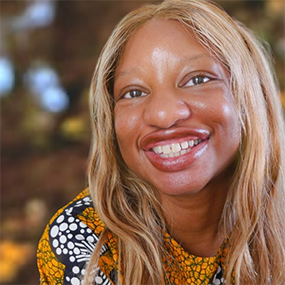
Jazzi Johnson
Managing Producer
Mark Bramhill
Senior Producer
Sam Johnson
Producer
Ariana Remmel
Fact Checker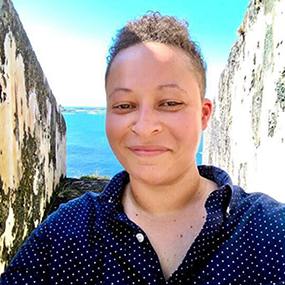
Jonese Franklin
Content DirectorBlue Dot Sessions
MusicCosmo Sheldrake
Music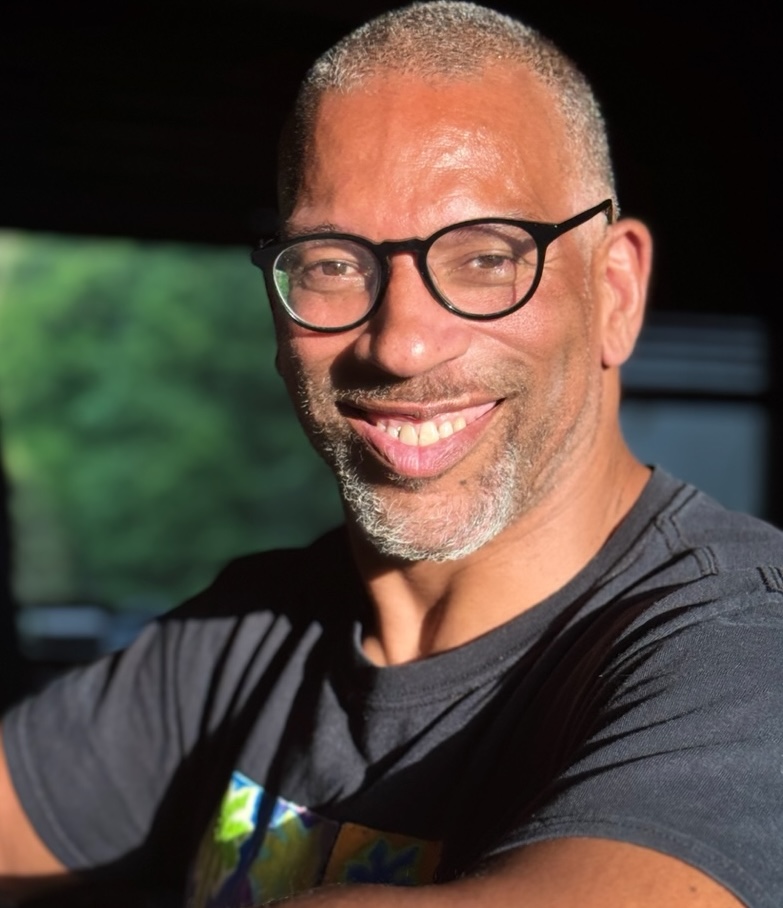
Christian Cooper is the Emmy-award-winning host of the National Geographic TV series Extraordinary Birder and is the author of the New York Times-bestselling memoir Better Living Through Birding. A former Marvel Comics editor and writer, Christian combined his passions in the Black Lives Matter graphic short story "It’s a Bird” from DC Comics and continues to seek synergy at the intersections of storytelling, progressivism, and environmentalism—including with his most recent work, the children’s book The Urban Owls.