
Join BirdNote tomorrow, November 30th!
Illustrator David Sibley and actor H. Jon Benjamin will face off in the bird illustration battle of the century during BirdNote's Year-end Celebration and Auction!
Farming a Future for Grassland Birds
Biologist Mike McGraw connects farmers and birders in the fight for conservation. (Season 9, Episode 5)

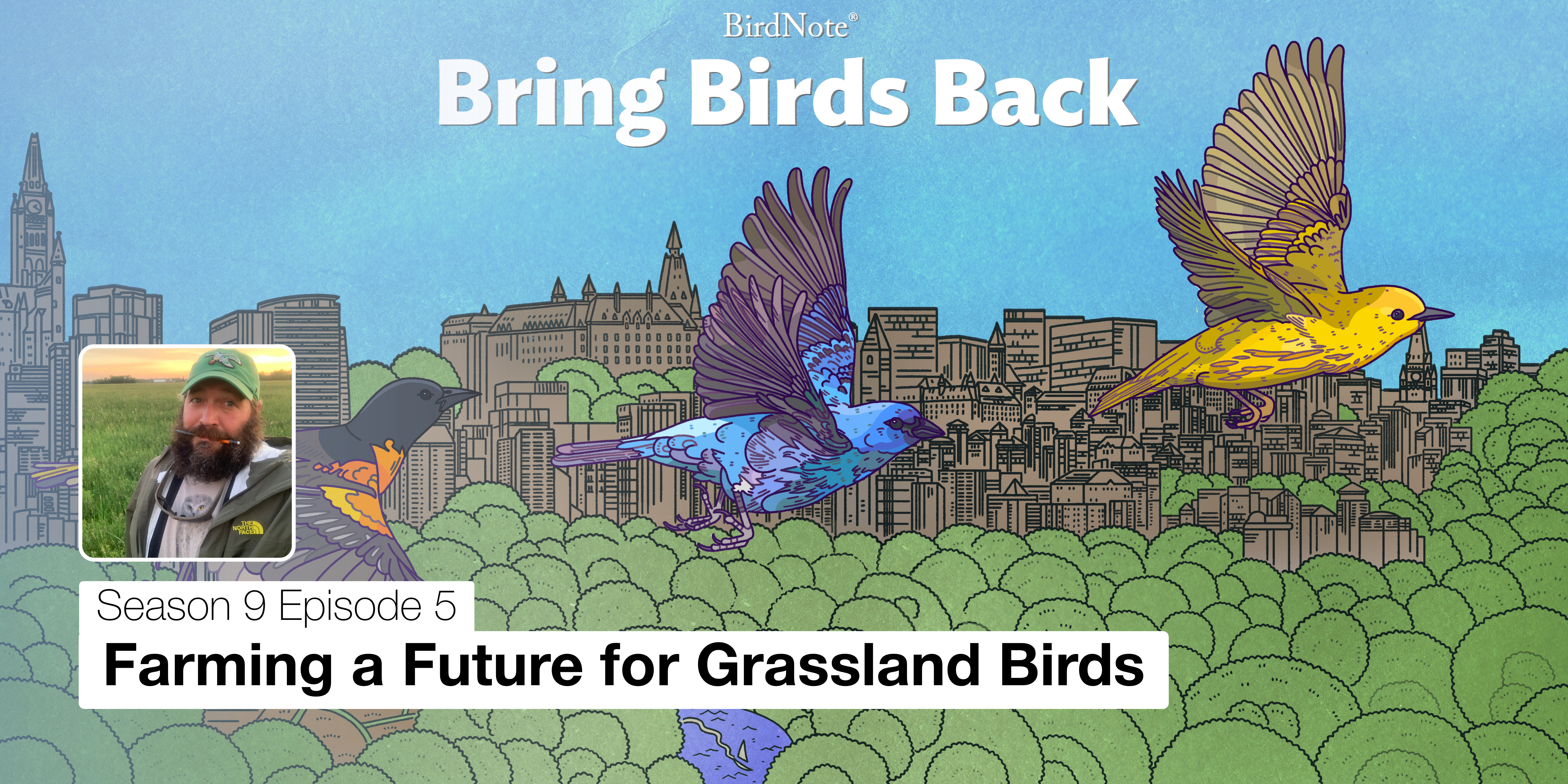
Dr. Deja Perkins talks with wildlife biologist Mike McGraw about Roots So Deep, a documentary by Peter Byck that explores the potential of regenerative agriculture to replenish and reinvigorate soil, grassland birds and their ecosystems. Mike talks about the research he and his team conducted in support of the film, with a focus on Adaptive Multi-Paddock (AMP) grazing, its connection to Indigenous cultures, and its impact on grassland soil and birds. We’ll talk about how farmers and birders are in the same fight and can work together to bring our birds back. Listen now!
Want more Bring Birds Back? Follow us on your favorite podcast app and on Instagram @BringBirdsBack!
To learn more about this topic and guest(s), read the episode transcript and other resources from this episode, visit our show page on BirdNote.org. Consider signing up for our weekly newsletter to stay up to date on what’s happening. For ad-free listening and other perks, sign up for BirdNote+ Plus here.
Get involved in our From Love to Action campaign when you visit this link!
BirdNote is a nonprofit. Your tax-deductible gift makes these shows possible. Please consider donating today!
Bring Birds Back Season 9 is sponsored by Teton Science Schools and the Cornell Lab of Ornithology’s Bird Academy.
[Bring Birds Back Stinger]
Deja Perkins: BirdNote Presents.
[music starts]
This is Bring Birds Back and I’m Dr. Deja Perkins.
How often do you think about the land beneath your feet? Not the buildings or the concrete, but the soil that provides the foundation for the food we eat, the habitats that wildlife and plants need, and more. If you're like most folks, you probably don’t think about it very often, but soil health is critical for birds and people alike.
About sixty percent of the land in the US - more than 1.3 BILLION acres - is privately owned, and well over half of those acres are farmland and ranchland. So, cultivators can play a huge role in land rehabilitation and sustainability– but how?
In this episode, we speak with conservationist and biologist, Mike McGraw, about the link between the agricultural practices of farmers and the conservation of grassland birds.
—------
Deja Perkins: Hi, Mike. Welcome to the show.
Mike McGraw: Hi, Deja. Pleasure to meet you.
Deja: Can you introduce yourself and a little bit about your work to our audience?
Mike: Yeah, sure. Uh, my name is Mike McGraw. I'm a senior wildlife biologist and ecologist. I work with a company called Princeton Hydro. It's a consulting firm. We do science and engineering, rad stuff. They let me run around the country chasing birds and snakes. I've been in the realm of consulting wildlife biology since around 2003.
Deja: Did you start off working with birds or was there another species that initially piqued your interest?
Mike: Yeah, appreciate you asking that. I didn't get into birds until I was a young adult, which is kinda crazy given how consuming it is in my life. When I was very young, I'd say my spark animal was a Northern Red Salamander.
I'd go to the little pocket park and just, like, self-soothe. One of the ways I did that was snooping around in the creek, catching salamanders and crayfish and stuff. And, uh, one time I saw this amazing salamander that was, like, four times the size of any one I ever saw, and it was, like, bright red. It blew my mind, and I've been chasing that wonder ever since.
So, like, I pursued science in my undergrad at Drexel University. I was in environmental science with a focus on ecology and, um herpetology– reptiles and amphibians. So I did some field research. I assisted some folks, radio tracking timber rattlesnakes and northern pine snakes in the New Jersey Pine Barrens.
Deja: Woah.
Mike: So yeah, it was really reptiles and amphibians that, uh, was my gateway drug into wildlife as like, "Oh my God, I could do this as a profession," you know?
Deja: Wow, you're a pretty brave man. I'm curious, was there a particular bird species that got you to switch from amphibians or reptiles to birds? Um, essentially, what was your spark bird?
Mike: Well, I would say first it was exposure to birders, right? There was a colleague who was a pretty good birder, and he was assisting this legend, Jim Dowdell, doing Bald Eagle surveys. And one day I was asked to fill in for him.
So, I was sitting out in the woods all day just monitoring Bald Eagles with Jim Dowdell, and it was in the fall and there's all these little birds just bounding through the trees. And, uh, he's just over the moon, just freaking out.
"Oh, there's a Blackpoll Warbler. There's a Bay-breasted Warbler. There's this, that," and he's losing his mind. I'm like, "What is so enticing about this?" And he started getting me on the birds and, like, explaining the differences. And I didn't realize, but, like, right there, he got me hooked. So it was really an experience just being surrounded by all these birds on an island and this grown man just giddy about all these birds.
I'd say, the first bird group that got me into, like, going out solo and seeking out birds was, uh, raptors. Going to the Rose Tree HawkWatch in Delaware County and just sitting there with amazing people and identifying birds that are, you know, 1,000 feet up streaming overhead, looking at raptors.
Deja: Yeah, those are- those are some of my favorites too.
Mike: Nice.
Deja: I mean, I don't know what it is about them, but they're just so large and majestic, and it's just so-- they get me every single time.
Mike: Yeah, you and me, both.
Deja: We first learned about your work in conversation with Peter Byck of Arizona State University — director, writer and producer of the 4-part docu-series, Roots So Deep. Tell us about this documentary and how it came about.
[curious music begins]
Mike: Sure. So, Roots So Deep is a documentary that was put together by Peter Byck. This really amazing documentarian whose pathway into this was carbon. You know, atmospheric carbon issues, climate change, right? And he found himself presented with this idea of this grazing strategy.
So, a whole team of scientists were invited to do research on working lands throughout the southeastern United States, to basically test this idea that this particular grazing practice - called adaptive multi-paddock grazing - can restore ecosystem services within the landscape that are often degraded or lost from continuous cattle grazing.
It took years to put it together. Lots of great minds. I came in after all of that. I used to work for a company called Applied Ecological Services. And the founder, this guy Steve Apfelbaum, he was one of the maverick scientists that Peter Byck reached out to when he first had an idea about this AMP grazing strategy. And Steve, because there was a bird element and he knows my skill set and love for birds, he said, "Hey, do you wanna help me with this project?"
So, I was as green as they come, right? Like I never had a social or familial connection to, like, food production. So, I just kinda walked into it blind. And urban ecology will always mean a lot to me. There's a social justice and environmental justice aspect. But yeah, I was very much steeped in that type of work and, to be honest, had some reservations. Came from the traditional conservation biology camp that, like, food production is really, really taxing on the landscape, and there's really a divide between working lands and conservation lands. But that was a blessing to get exposed to this practice that really flips that idea on its head.
I very much encourage people to, at the very least, watch the trailer, which explains this pretty well, but also, you know, take the time and watch the docuseries. It's a really powerful story.
Deja: Yeah absolutely. And I can identify with so much of that being from Chicago and just being completely disconnected from where our food comes from. And, just to piggyback off of what you said earlier about how originally you didn't think farming and the environment really went together, I think that is a common narrative shared within environmental science and conservation. A perspective that, you know, farming as it's done now, is just bad for birds, it's bad for the environment and conservation as a whole.
[end curious music]
Deja: So adaptive multi-paddock grazing, A-M-P or "AMP", has some key differences from traditional grazing practices. Can you describe those differences for our audience?"
Mike: So yeah, so, your standard continuous grazing is one or two or maybe three really big pastures. There's a permanent fence line, the cows are in there, they can graze where they want, they can lay down where they want, they spend a lot of time in the same space.
Adaptive multi-paddock grazing will take that same big pasture, but draw a temporary fence line of a much smaller space. Let's say you got 200 head of cattle on 200 acres. Let's take 10 of those acres, put all the cows in there, let them feed there for a day.
The next morning, the farmer comes out, draws a new fence, takes 10 to 20 minutes to set that up, opens the fence, they go into there and they feed there, right? And so what you're doing is you're allowing them ample food per day, but then you're restricting them from walking around, trampling, overgrazing those areas after they've been grazed.
So you're giving an aggressive grazing impact, and then significant rest thereafter. So good AMP grazing typically would involve moving cows once a day, maybe even twice a day, maybe once every two days, right? That range. But then once that land is grazed, giving a minimum of 60 days, preferably closer to 100 or 120 days rest. And that re-stitches together that co-evolved magic of bison or wapiti elk moving through a space, grazing heavily, putting that impact down, and then disappearing. Yeah.
Deja: Yeah. And I know that the Roots So Deep project brought in a bunch of different scientists, but you in particular were looking at the impact of AMP grazing on birds. So can you summarize what you and your team did to study this impact of regenerative agriculture on birds?
[Begins sound design with bird sounds]
Mike: Yeah, sure. So, most of the comparisons, there's literally one fence between them, they're neighbors, — where one is doing continuous grazing and the other one's doing AMP grazing on the same soil beds in the same biome, same rainfall, et cetera. We collected bird data within these spaces just to see if there's any impacts, any differences. And we found resoundingly statistically significant, abundance of birds within grassland obligate nesting birds. And the grassland birds in the southeast that we found had a notable, like, very, very statistically significant difference in abundance and presence were Eastern Meadowlark, Savanna Sparrow, Grasshopper Sparrow, and Dickcissel.
Um, some of the other bird species that we saw directly benefit from AMP grazing, that very likely are negatively impacted by continuous grazing are Northern Bobwhite, which is a species of ground nesting bird. It's a game bird that used to be much more present in the landscape and has just kind of disappeared. It's a species that not only birders like myself love, but also hunters.
It really piqued a lot of interest. A lot of these farmers are like, "Hey, how do I get bobwhite back on my landscape?" Once they learn that like, "Oh, my neighbor's got bobwhites? That's crazy to me. I haven't seen them on this property since I was a little kid." That was kind of their gateway into being interested in, you know, adopting some AMP practices, which is really cool.
Deja: Yeah that's really awesome. And so I know you found these statistically significant differences between AMP grazed paddocks and non-AMP grazed paddocks, but what exactly does that mean for the grassland birds and the ecotonal birds? Like, were there higher populations? Did they breed more? Like, what exactly does that mean for them?
Mike: Yeah. So, I think there were seven different types of scientists collecting data, and all of us found statistically significant changes, whether that was vegetation, water-holding capacity, insects, even animal health.
So, collectively, we can say, scientifically, there's this holistic benefit, like Eastern Meadowlark is a very hardy grassland bird. You can find them in overgrazed pastures. They eke out a living. They're pretty resourceful. We had one comparison site in Woodville, Mississippi, where the continuous grazer — a wonderful family, they love their land, they do a great job at what they know — I found, I think, one or two calling male Eastern Meadowlarks from one point on their property. We had four points at each of these. Conversely, on the AMP graze side, there was a minimum of six counter-singing male Eastern Meadowlarks from each point, right? And so what does that mean?
For example, I can see us as two squares on the screen right now. Let's assume that my square is one acre and your square is one acre. If within this one acre, I have to use every bit of this to find enough food, to gather enough nesting material, to make sure that my partner is sitting on eggs without being predated. Once those young are born, I'm constantly running food to feed those young. They require tens of thousands of insects. Let's say all of a sudden your habitat gets better. You only need one quarter of that space to find everything you need. So you don't mind if somebody shows up right here and right here and right here. So now you have more neighbors. It's because there's more resources.
So, this is- this is painting the picture of grassland birds in precipitous decline, which is what's happening in North America, right? And right here is showing us a story of, oh my goodness, not only are they not in decline, this could be a part of the solution to bring these birds back in the numbers. You know, three-quarters of all Eastern Meadowlarks are gone.
I was in Woodville, Mississippi, and I watched a robust, high-functioning population of Eastern Meadowlarks in this AMP grazed scenario. Now listen, it's not just the movement. There's more biomass. The grass there was on average waist high. In the morning, you see spiderwebs throughout. There's pollinating insects buzzing all around. It's just alive. Again, it's that holistic change, right? The whole landscape is being healed; managing the animals to manage grass is the key.
[/end of music/sound design]
Deja: I completely hear what you're saying. Through, um, adaptive multi-paddock grazing, we can improve the habitat quality, which means we're improving the resources, and we can support more birds on a smaller area because they don't have to go as far to find their resources. So by just doing that one simple thing, we are bringing the birds back.
Mike: And Deja, here’s the- here’s the crazy thing– [cutoff]
Deja: More on Mike’s profound discovery, the historical context of AMP grazing, and practical ways this method can boost organic and ecological production– after these messages.
[music transition]
MIDROLL
[music transition]
Deja Perkins: And we’re back with Mike McGraw of Princeton Hydro. I’m Dr. Deja Perkins and we’ve been discussing Mike’s role as part of the research team for the Roots So Deep docu-series, which follows their investigation into the effects adaptive multi-paddock grazing, or AMP grazing, has on bird habitat, bird breeding, and more.
Now, back to Mike’s enthusiastic conviction about what he deems the greatest impact of all:[u]
[musical shift/ends]
Mike McGraw: Deja, here's the- here's the crazy thing. Like, this is why it's so beautiful. This is why I think, like, this'll work. You don't have to be an ecologist, you don't have to even care about birds. This practice could have noticeable impacts, changes to your biomass on an overgrazed pasture in two years in the southeast.
The A is “adaptive,” and that's important because if you're in the northern Great Plains, if you're in northern North Dakota versus the southeast, it's gonna take longer for grass to grow. It might take five years doing the same practice in the northern Great Plains. It might take even longer if you're in the desert. But guess what? We know ranchers that are doing this in all these different biomes, it is successful throughout. But you have to be adaptive. You might need larger sub-paddocks, and grazing a little longer in order to make that system work but it's gonna work.
There's what? 2.3 billion acres in the United States; Of that, like, 790 million acres is impacted by grazing. That's a lot. Like, it's not half, but it's getting damn close to it. We've proven that good farming practices that are good for the farmer can also be really good for wildlife and vascular plants, and all these other amazing things, water holding capacity. And then, Peter's love, which is, you know, carbon sequestration. We've proven that we can sequester atmospheric carbon through this process. So, I think the reason this can work is because it's an economic model for farmers, and the symptom is really healthy landscapes.
Deja Perkins: Can you actually share a little bit more about the impact to carbon and how AMP methods can help reduce the carbon footprint?
Mike: I could try a little, but I'm definitely tipping over my skis. I'm a wildlife biologist, birds and snakes are my bailiwick. But, uh, it's funny because in ecology there's ecological sinks and sources. And, like, a sink is an area where you attract something and then it fails.
In carbon, it's the opposite. A sink is a good thing. You're pulling down carbon from the atmosphere and putting it into the soil. There's a study that checked not just carbon, but also all the greenhouse gases and found that, um, grazing lands both actually were half decent at sinking, but there was a lot of release in the continuous grazed pastures where the AMP grazed pastures held that, and a lot of it got converted into long-term carbon.
And part of that magic is soil microbes and how important soil microbes are. And a healthy soil has a lot of dead soil microbes, and that's long-term soil carbon. And their relationship with plants is how the magic happens as a pump to pull atmospheric carbon out of the sky. So, we know that as a system, there's a noted benefit.
Deja Perkins: So, obviously, I would think that your perspective on grazing has changed since you began working with the Roots So Deep project. How do you feel now about the connection between farming and conservation?
[slow / intimate music begins]
Mike: Uh, yes, my perspective has changed dramatically but like most things in life, it's very complex, right? There are still many, many farming practices that result in loss of soil carbon, erosion, simplification of biodiversity, et cetera.
However, all the best examples are the Indigenous predecessors and current, extant Indigenous folks. I mean, anywhere you go on the globe, Indigenous populations often have these really ingenious and beautiful, harmonious ways to work within the landscape. Very sustainable practices. And to be specific to North America, just a cornucopia of amazing Indigenous cultures that had evidenced managing landscapes to influence how millions and millions of bison or wapiti elk, that are migratory, move through the landscape and they would seasonally be able to benefit from hunting these animals. There's a co-evolution with the plants and the insects and the way the soil interacts, right? Also, most of our native grasslands are influenced by fire and grazing in the United States. Really, really heavy impacts that don't last a lot of time, and then a lot of rest. So, a lot of the farming practices that can mimic functional ecosystems have that basic principle within them.
There's profit-driven things that have steered people away from those co-evolved practices. So to maximize your yield may involve increasing the size of your fields; simplifying the diversity of your forages; tilling throughout the year and then plant one species over thousands of acres, and hyper manage with pesticides, herbicides, fertilizers to keep this system going. This exacerbation of simplifying landscapes and adding a lot of pressure and then subsidizing the resurgence of that annually is a profitable market for some. But at the end of the day, the landowner suffers, because soil is a bank account and if you keep raiding the bank account, eventually you're gonna run out of resources.
Deja: I just, I think about how all of these practices that have been used in, like, more recent years when it comes to agriculture for profit. Like you said, it's so much about the monoculture; it takes away from the diversity, it increases pests and disease. Whereas, you know, if we were using cover crops or something else, you know, it would be helpful to help put nutrients back into the soil. It's just, yeah–
Mike: Yeah, and Deja, here's the thing: If you look at the links in the chain to get from a grazing cow in North Dakota to a steak on a plate in Southwest Philadelphia, there's a lot of links in that chain, right? And there's money to be made throughout that. The continuous grazing practice of, like, keeping your cows in one or maybe two pastures all year, the farmers do a really good job at raising a whole bunch of young cows and then selling those cows to feedlots where they end up being grain-finished, slaughtered in mass, right? They end up being just that first link in the chain. They're just following a business model that they were taught either by their neighbors, their parents, or whatever. But once people recognize this adaptive multi-paddock thing and embrace it, essentially they become links one, two, three, maybe even four in that; before that higher value meat makes its way to a dinner table in Southwest Philly.
If you can challenge that system a little bit and try some of these strategies, I think there's implications that are beneficial across the board.
[/end music]
Deja: So in order for this process to work, farmers and scientists had to work together. So throughout your experience working on the project, how receptive were the farmers to these ideas? And for those that were hesitant, what was your main pitching point to get farmers involved in doing sustainable ag for bird conservation?
Mike: There was no pitch, and that's the beauty of Peter's approach. He truly came in as an unbiased observer with intense gratitude for us to be on the land. We studied. We minimized our impacts while on their landscape, and we shared the data, and the data spoke for itself.
Some of these ranchers had been grazing using adaptive multi-paddock practices for 10, 15 years. These are leaders in this field, right? Like they already know this stuff. Some of them have been enacting AMP grazing for years; some are curious; some had zero interest and the only reason they allowed us on their land is because they trusted their neighbor.
The question of, could we get the continuous grazers - our controls if you will - to be interested in AMP grazing was something we were all kind of interested in, but nobody had any expectations for, right?
For some, it's economics. Like, wait, I don't have to spend $30,000 on fertilizer every year? Or 15 grand on pesticide or herbicides? Like, I can let the cows graze these weeds, right?
Wait, like, my meat will still be worth the same at the end, but I'm not starting in the hole. I could start paying down some debt or whatever. And then for others it was the biodiversity. Like Marie Levesque, I tear up every time I see this part of the film. She was crushed that there was no grassland birds on her land. She's like, "What?" Like, "We're farming because we care about land. We're doing what we know is best." And she was crestfallen to see the science that there weren't grassland breeding birds on her land. She was like, "How do I do better?"
You'd be pleased to know she's got breeding grassland birds on her property now, 'cause she adopted adaptive multi-paddock practices.
Cooper and Katie Hurst down in Mississippi, they experienced a drought. Their neighbors were struggling, having to sell off cows, having to buy more hay, having to start switching to hay earlier in the season. They were so flush with biomass that they had zero problems, right? They didn't have to freak out because they had been doing AMP grazing for so long, they're moving their animals in a way where they're always flush with biomass. There's always a sub paddock to open up that has plenty of food. So they were able to breeze through a drought. And so for all the neighbors, it's like, bing, a light bulb goes off.
Deja: And so, we've talked about all of these benefits for conservation. We've talked about all of these different benefits for farmers. What's the most important takeaway for farmers and then what's the most important takeaway for conservation when it comes to AMP grazing?
Mike: Yeah, okay. So, that's a great question.
[Begins insightful music]
I'm gonna start with the conservation one- I would say the first thing to do is to walk through a door and leave all your pre-connotations behind you. Do a factory reset in your brain and then try to put yourselves in the shoes of someone who grew up on a family farm. Start to look at the science that shows that working lands can functionally, objectively be highly productive conservation lands.
Birds, insects, have the amazing ability to just pick up and fly. It's a little harder for large scale ungulates. Let's face it, the reason bison are a postage stamp of what they once were– there was a functional agent of genocide, right? Most bison were hunted and bounty killed to help starve and control Indigenous people when United States was colonized, essentially. So, we have a postage stamp of bison left. Some of the large migratory pathways exist, but there's fences and highways and bridges.
So the current landscape we live in, we need to redefine our relationship as people, our relationship with the land, our relationship with grazers, and the best proxy to restitch that co-evolved system, is grazing on pasture land in North America.
And that's a direct segue into the flip side. For farmers, again, check all your pre-connotations at the door. Go back to just being a human being, loving your neighbor, caring about the things that we should care about on this planet, and, all of a sudden you realize, like, by being a good steward of your land, by being a good steward of your, your cattle, by, minimizing the amount of inputs you need on your land to raise good food– the byproduct is you've just become a conservation biologist.
You're actively supporting native plants. You're actively supporting grassland birds. You're actively promoting a diverse insect biome that has predator checks and all these things. You're stitching together magic, just moving animals in a way that's economically beneficial to you, has a symptom, a byproduct of conservation biology.
This working land solution has an opportunity to cause a lot of healing and have people that otherwise would be, uh, not at the same table breaking bread together, and it's, it's a beautiful thing.
[/end music]
Deja: No, absolutely. I think that's a wonderful message to kind of close us out. Do you have any other things you kind of wanna tell our audience?
Mike: Yeah, sure. Be on the lookout for another publication doing this same exact study design that we did in the Southeast. We did it in the Northern Great Plains. Spoiler alert, we found, again, significant benefits to birds. Huge shout-out to, uh, Prairie Soul Meats, I just bought another half cow from them. Over 100 breeding bird species on their land, and they're moving cows every day. They're hardcore North Dakota badass farmers. I've never been on land that has more breeding birds in North America. They're just killing it. So, yeah, look for that paper.
Um, Go birding every day!
Deja: Yeah go birding every day, yeah.
Mike: I don’t know what else to say. Bird every day, you know?
Deja: Do you have any, any social plugs or the plug for the documentary that you can share?
Mike McGraw: Absolutely. So on socials, it's Carbon Cowboys. It's the Roots So Deep team. So rootssodeep.org is the way to stream the docuseries. There's lots of pop-ups. One could happen near you, so look for those, right? Peter's doing the roadshow all the time.
Check out Princeton Hydro. You know, that's our company. We're doing a lot of this regenerative agriculture work in partnership with a whole bunch of other rad scientists and researchers.
Deja: Awesome. Thank you so much, Mike, for coming on the show and sharing your knowledge and your passion and love for birds with us.
Mike: Thank you so much, Deja. I could talk about birds with you all day.
[music transition starts]
Deja: While farming and protecting the environment may seem contradictory to some, the work of the Roots So Deep team challenges that notion. One thing I appreciate from this conversation with Mike, is how much this project highlights how farmers and scientists can and should work together.
Farmers, whether first or fifth generation, know their land. They understand the challenges on the ground because they live it every day. Making strides towards what should be our unified goal of conserving the land, water, and soil that we all rely on, doesn’t require sacrificing the economic output that farmers need to survive.
Through sustainable agricultural practices, we can conserve our grasslands, create more habitat, feed our communities, and bring birds back. There are so many gems throughout this episode that I hope our listeners sit with. And hopefully, some of you are farmers, or will share this with farmers, who can consider these practices on their own land. Because it takes all of us to help protect this place we call home.
Many thanks to Mike McGraw, Peter Byck, and the rest of the Roots So Deep team for their work and willingness to share their findings with us.
To learn more about the Roots So Deep documentary and to read more about their studies, check out the resources for this episode at BirdNote dot org.
And follow us @ Bring Birds Back on Instagram for the latest updates about the show!
This episode of Bring Birds Back was created by our BirdNote production team, including Fact-checker Conor Gearin; Producer Josh Fisher; Producer Sam Johnson, Senior Producer Mark Bramhill; Managing Producer Jazzi Johnson; and Content Director Jonese Franklin.
Our music is by Blue Dot Sessions and Cosmo Sheldrake. And this episode was hosted and co-produced by me, Dr. Deja Perkins.
Thanks for listening!
[Music ends]
Post-Credit
Deja: I already know what you’re gonna say. I just feel like I already know what you're going to say.
[Managing Producer] Jazzi: What? [Chokes on laughter]
Deja: I was tripping over some words so I gotta read it again. Was the energy better that way or no?
Jazzi: “No, it’s fine!”

Deja Perkins
Host Narrator
Jazzi Johnson
Managing Producer
Sam Johnson
Producer
Josh Fisher
Producer
Conor Gearin
Fact Checker
Mark Bramhill
Senior Producer
Jonese Franklin
Content Director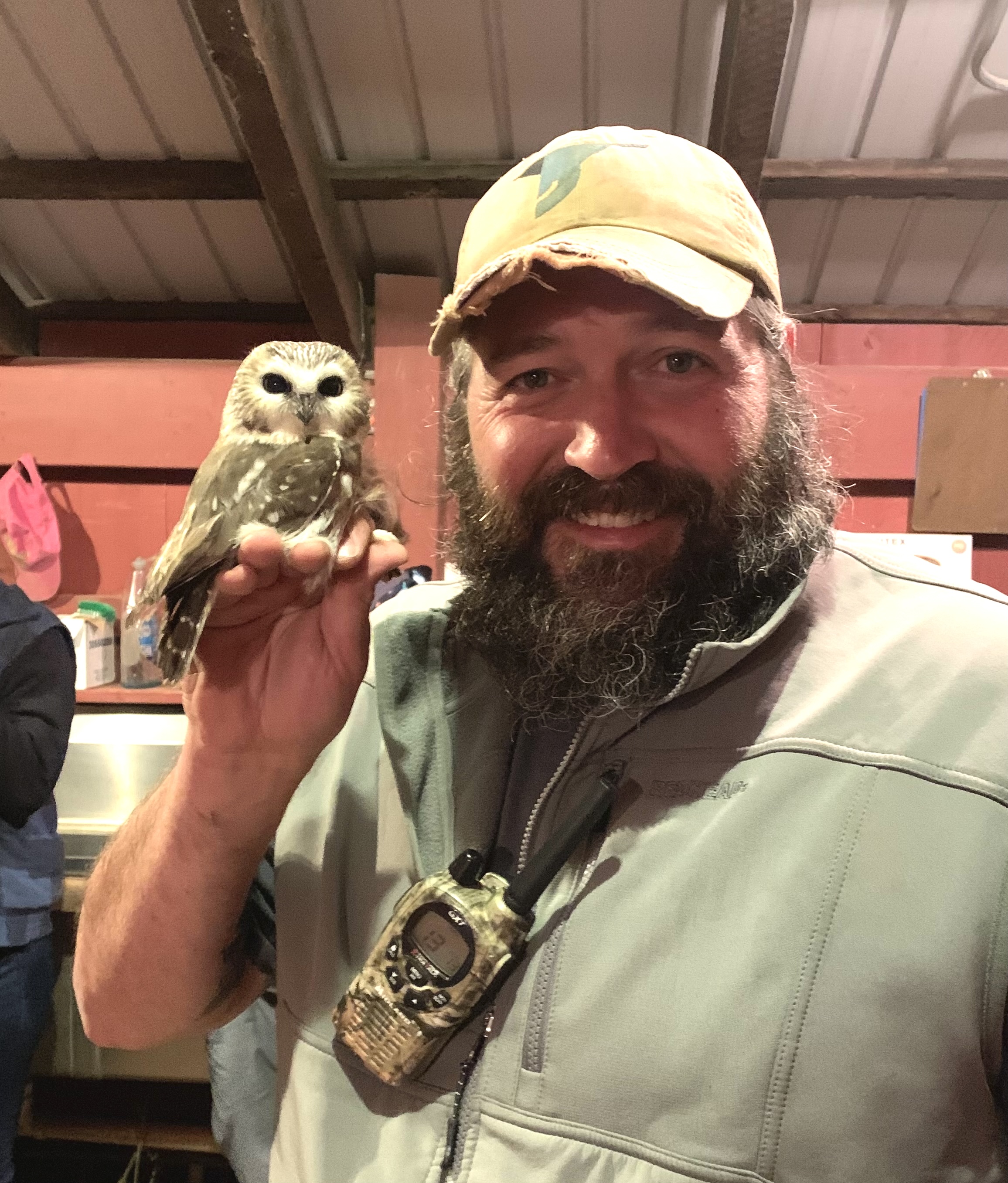
Mike McGraw is a Senior Wildlife Biologist and Ecologist with more than 25 years of experience leading ecological research, conservation planning, and habitat restoration projects across North America. A nationally recognized expert in wildlife ecology and regenerative working land management, he has directed studies spanning 45 states, four Canadian provinces, Puerto Rico, and Kauai, with a particular focus on avian, reptile, amphibian, and sensitive species communities. His collaborative research on regenerative agriculture and grassland bird conservation has produced peer-reviewed publications, informed restoration and stewardship practices across working landscapes, and earned national recognition through the documentary series Roots So Deep and appearances on a variety of nature-related podcasts.
Mike is also proud father of three amazing daughters and spends most of his free time enjoying fatherhood, exploring nature and art, and tending to a robust personal native plant garden with his family and partner.