
Join BirdNote tomorrow, November 30th!
Illustrator David Sibley and actor H. Jon Benjamin will face off in the bird illustration battle of the century during BirdNote's Year-end Celebration and Auction!
John Mittermeier and the Lost Birds
Can bird tourism improve conservation abroad? (Season 9 Episode 3)

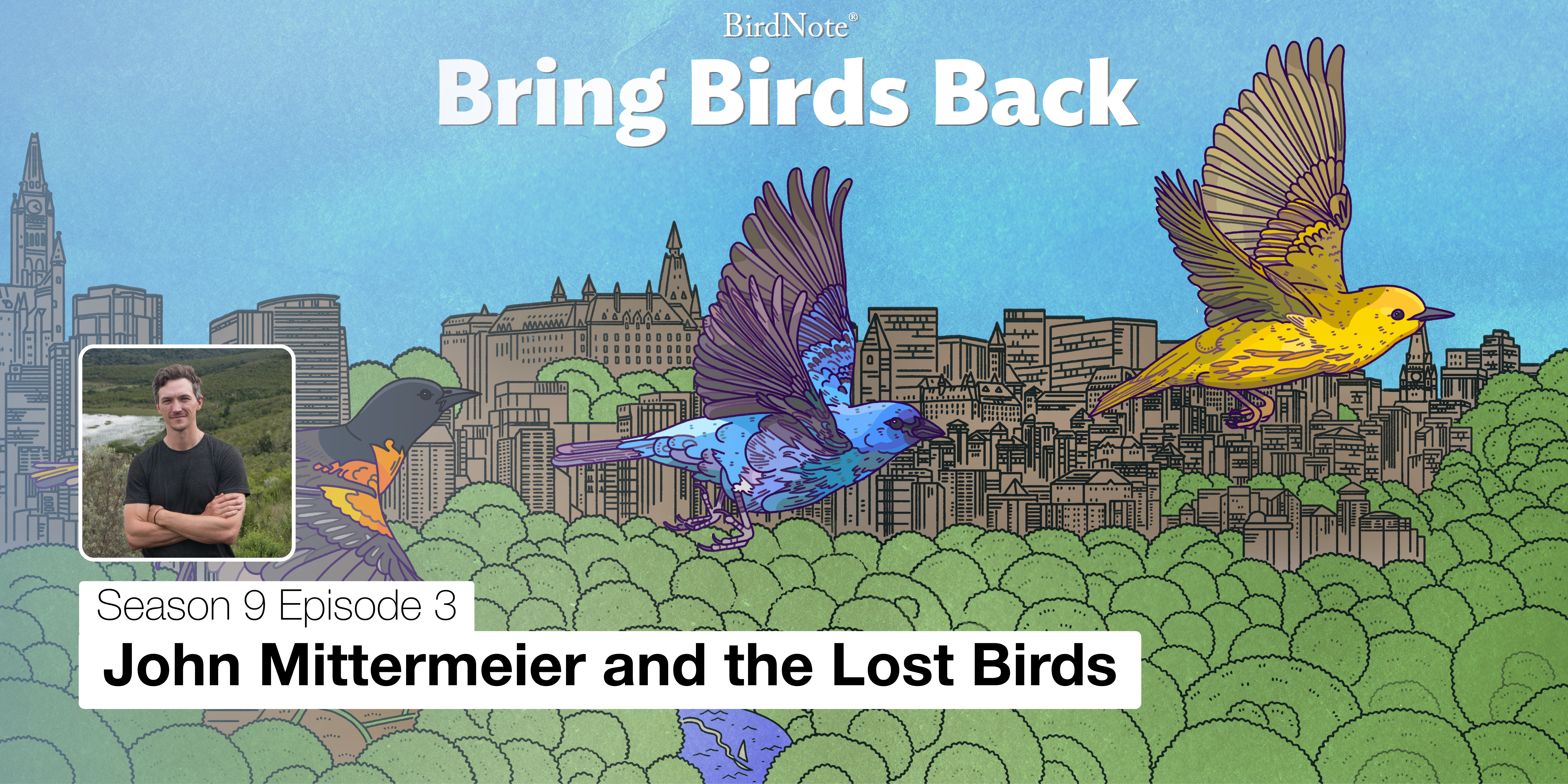
What happens when a bird disappears—and how do you find it again? Dr. Deja Perkins sits down with John Mittermeier to explore American Bird Conservancy’s conservation partnership, Search for Lost Birds. We talk about what qualifies a species as “lost” and why finding these birds can be a catalyst for conservation funding and protection. John also shares incredible stories from the field, including the rediscoveries of the Dusky Tetraka and the Black-naped Pheasant-Pigeon. It’s a conversation about curiosity, exploration, and why finding one missing bird can make a big difference for an entire ecosystem. Press play!
Want more Bring Birds Back? Follow us on your favorite podcast app and on Instagram @BringBirdsBack!
To learn more about this topic and guest(s), read the episode transcript and other resources from this episode, visit our show page on BirdNote.org. Consider signing up for our weekly newsletter to stay up to date on what’s happening. For ad-free listening and other perks, sign up for BirdNote+ Plus here.
Get involved in our From Love to Action campaign when you visit this link!
BirdNote is a nonprofit. Your tax-deductible gift makes these shows possible. Please consider donating today!
Bring Birds Back Season 9 is sponsored by Teton Science Schools and the Cornell Lab of Ornithology’s Bird Academy.
[Bring Birds Back Stinger]
Deja Perkins: BirdNote Presents.
[music starts]
This is Bring Birds Back and I’m Dr. Deja Perkins.
When you think about extinction, you probably think of the Dodo Bird or the Passenger Pigeon, but at what point is an animal considered extinct? Some birders hold out hope for sightings of birds like the Ivory-billed Woodpecker, but that bird hasn’t been seen in years. How do we know the difference between when a species is extinct, lost or just not seen for a long time? And whose job is it to look for those species? In this episode, we speak with John Mittermeier from the American Bird Conservancy about “lost birds” and the people that work together to find them.
—------
Deja: Hi, John. Can you introduce yourself to our audience and your work?
John Mittermeier: I'm John Mittermeier, the Director of the Search for Lost Birds at American Bird Conservancy.[c] So I lead a program with American Bird Conservancy and a couple other partner organizations, BirdLife International and Re:wild, to try to support searches for birds around the world that are currently lost.
Deja: That sounds like pretty important work. Can you tell us a little bit more about the mission and purpose of this project?
John: So, when I say ‘lost,’ you know, that's a word that will mean a lot of different things to different people. For our purposes, we have a very specific definition and this is based off a publication that came out a few years ago. When we're referring to lost, we're saying birds that are not considered extinct but have no confirmed and independently verifiable records in the forms of photographs, sound recordings, or genetic materials that might be a blood sample or a specimen in the last 10 years. So that's no records in 10 years.
We've done a global analysis, and we've come up with a list of about 150 or so species that meet that criteria. And the purpose of the partnership is that, if we can't find a bird, it's really hard to develop any conservation action for it or to know what's happening with it. We see a clear conservation value in trying to find these species and figure out what's going on with them.
Deja: So what would be an example of one of these lost birds you all are trying to find?
John: Well, there'll be a couple of examples close to home for any listeners in the United States. Probably the most, sort of, famous example is the Ivory-billed Woodpecker, [Ivory-billed Woodpecker call] a species that some people will probably say is extinct, others might still be holding out hope for. You know, I know there have been some reports of it and some records but it's not yet officially listed as extinct.
There are also a couple other species in the United States that meet this definition: Bachman's Warbler and Eskimo Curlew[d]. And then, if we expand this out to the whole world, there's about 150 or so species that have appeared on the list since we started doing this.
And that includes some really rare and possibly extinct birds, like those ones I just mentioned in the United States, and also some birds that are currently not considered threatened, but just happen to be in areas where, maybe people haven't visited or maybe we don't have good information on the ground to understand what's happening with them.
Deja: Hmm. So you mentioned there are about 150 species on this list. How do you all choose what birds to focus on and to make a priority?
John: So, we started this list– we first launched it in 2022. Because we have this 10-year timeframe; species can get added to the list each year. So when we first started, it was 142 species that met the criteria. Since then, there's been 162, so 20-some have been added to the list at various points, but a lot of them have been found. So, current lost birds is 110 species. So that's a pretty good success rate.
And to go back to your question of saying how do we prioritize amongst them: you know, conservation threat status is definitely a consideration there. So some of these birds that are considered critically endangered or endangered, obviously that means that there's a high conservation priority. But by and large, I think we just wanna find all of the lost birds. So we wanna put these 110 species out there as a global challenge to birders, conservationists, whoever's interest around the world.
And, there may be some that are more threatened than others, but all of them would be really wonderful things to find.
Deja: It's pretty awesome that you guys were able to find 40 species and kind of knock that number down to 110. I'm curious, who are all the partners on this project, and what sparked its creation initially?
John: So the initial creation of it comes from, basically, all of those three main partner organizations that I mentioned. So American Bird Conservancy, we work on bird conservation projects in the United States and across the Americas. And particularly with our international work, we've supported searches to find species that were lost. Purely for the reason because we know these are conservation priorities. If you can't find something, we can't do conservation on it. So it's something that we've been doing as an organization for 20-plus years.
BirdLife International, they do the Red List assessments for birds around the world, so this is also a priority for them, and they've come up with lists of species in the past that are targets for birders to search for.
And then Re:wild, our third partner there, they're an Austin, Texas-based conservation organization, and they've had a search for lost species I think since 2018, that's focused on a number of groups,including lost amphibians and lost sharks and lost mammals. And so, it sort of fits really well between all these organizations and our mission and, with that in mind, in 2021 we came together and said, "Let's formalize this into a Search for Lost Birds partnership and really focus on it and see what we can do to find these birds."
[Music starts]
Deja: There are so many organizations that are working together to push forth this mission. I feel like this is something that the everyday person might not think about, but it is really important work to measure and look at how many species are endangered or threatened.
So I'm curious, have you yourself been out into the field to locate a bird that is on this list? And how do you choose and pick who works on each mission?
John: So, I have done a couple of searches for lost birds myself. I have a longstanding personal interest in this. Actually, when I was doing my undergraduate work, I got some funding to do a project in Samoa looking for a bird called the Samoan Moorhen, which was a lost bird at the time.
It had not been definitely documented since the 1870s, but there were parts of a few of the islands on Samoa, including Savai'i, where people had not really looked that hard for it. So I spent a lot of time going around the mountains, going around the forest, talking to local people, asking if they'd seen this bird. [I] did not find it. But that really sparked a longstanding interest for me. And actually, I think the experience of not finding it was also really powerful and gave me a lifelong interest in these lost birds. And I've participated in a number of expeditions and searches since then.
To answer your bigger question about how do we find partners, who gets involved in these searches– I guess I'll call it a bit of a grassroots approach here. You know,[e] the people who are usually best suited to find these birds are people who are from the areas where they occur, right? So those may be locally or nationally based bird watchers or conservation groups. And a lot of the rediscoveries that have happened have been driven by those types of people who have either just found the bird themselves and we've helped them share the result and get the word out there, or in some cases have come to us and said, "Hey, we're really interested in this bird. Can you help us with some technical support or some funding support?" Or whatever other needs they might have.
So I think rather than it being a top-down process of us specifically selecting, we're really trying to support all the people out there who are already interested in these species and searching for them.
Deja: I love that you all work with folks who are already interested and kind of on the ground in order to accomplish this mission. And I'm wondering what role participatory science citizen science apps like eBird or iNaturalist play, if at all, in helping you identify these species?
John: They play a huge role. So, we have our three core partners but we also have as a content partner we work with, Birds of the World, and we collaborate very closely with Macaulay Library– the media branch of eBird there. So if you think about that, the definition that I mentioned for these lost birds, which is primarily driven by documented records, right? And really, media-documented records tend to be the most co-common type of documentation. And so, these databases like iNaturalist, eBird, where all these people from around the world are submitting photographs, are submitting sound recordings, are the foundation for us to figure out which birds should or should not be lost.
So we really start with those platforms as our first step to identifying potential lost birds, and then we'll supplement the information that's in there with scientific review of published literature, reaching out to people in particular areas where we feel like there might not be records represented in those and things like that.
So those databases are vital and a great part of this initiative.
[Music ends]
Deja: I am a little curious, a lot of scientific work capitalizes off of the effort of bird reports from these apps, but my doctoral research found that eBird reports or observations are not common in predominantly POC and low income communities here in the US. This is something that can be kind of extrapolated out to the larger, global community.
It's even more true in the Global South, which I'm sure overlaps a lot with the areas that you all are looking for these lost species. So do you think that this can, maybe, play a role or cause some difficulty in y'all's mission?
John: So obviously there's a geographic bias and a distribution in where records are submitted to these different databases, like eBird, records are skewed towards North America and the United States. Another database we use, Xeno-Canto, that's sort of biased towards Europe. And then there's some records, databases like WikiAves that's Brazilian-based, so their records are really biased towards Brazil.
So as we're relying on those databases as a first point of contact, we are subject to the biases that they have in their distribution. If you look then at the results of where lost birds end up occurring, you definitely see some patterns with certain regions of the world where we're not able to capture information that might be there, right?
So a really obvious one that stands out is the island of New Guinea. There are not a lot of people there submitting these types of records, or a lot of the knowledge that I think is there, largely with local communities and things like that, is not knowledge that we're able to access in these databases.
So there's probably a good number of birds in that region that someone on the ground there has seen and actually knows. And so it's not really technically lost in how you might imagine that definition, but it's still lost to us based on how we're defining it. So trying to build those bridges and connect with people in those places is a key component to being able to achieve this mission of finding these birds.
Deja: I really love that you all are, kind of, like working around those challenges and working with communities on the ground to verify. Like you said, a species may be new to us, but it's not new to the community that is local to there.
So it's great that you all are working with folks who are on the ground to really figure out: are these birds truly lost or does Western science just not know about it?
……
John: Yeah, I can tell you just a great example on that front is the project that we were part of a few years ago to look for a bird in Eastern New Guinea called the Black-naped Pheasant Pigeon.
[music selection begins]
So this is a large, pretty distinctive-looking terrestrial bird, found on a single island off the eastern tip of New Guinea. [Bird sound] To be clear, this bird sound is not the Black-naped Pheasant Pigeon. The Black-naped Pheasant Pigeon, according to naturalist Andrew Goldie’s description from the 1880s, sounds more like “a sort of ké-o, the ‘o’ being prolonged.” Which many researchers, including John, believe to sound identical to the mournful calls of other Pheasant Pigeons, which is what you’re hearing now. [Bird sound] Similar to many long-time lost birds, the Black-naped Pheasant Pigeon has yet to be sound recorded.
From a scientific perspective, the last documented record of this species was 1896. So when we were there in 2022 looking for this bird, it had been well over a century that we had no scientific record of it, right? Is it still there? Is it extinct?
What's going on with it? Just [a] total mystery from our scientific knowledge base.
But there's a lot of local people who live on this island, many of whom spend a lot of time in the forest, are super knowledgeable about birds, are super familiar with different bird species that are there. And so, actually the process of trying to find the pheasant pigeon[p] was primarily about interviewing people on Fergusson Island, trying to understand if they'd seen this bird, seeing if they knew about it, and that in the end ended up resulting in finding the bird.
An interesting component of that is actually, a lot of the people we spoke with didn't know the bird, so it wasn't a sense of just like everybody knew it and we didn't. But in the end, we did find some people who happened to be going to places where this bird occurred, spending a little more time in the habitat, and knew it.
And for them, they were like, "Oh, yeah, I know the local name of this bird. I can tell you exactly where it is," took us to the exact spot, and we ended up getting a camera trap photo of it there. So, you know, that's just a perfect example of what you just said there. It was lost to us, but not lost to the people who happened to be living in that particular place.
Deja: And I'm pretty sure that whole experience and these stories really are, like, a feel-good moment and bring about just pride and accomplishment from just being able to capture, like you said, the bird on a camera trap. That's, like, pretty exciting. So, I know that in 2024 you were a part of a group that found a lost bird in Peru. Is it the– [attempts to pronounce]. Help me out!
John: Vilcabamba Inca. Yes!
Deja: Thank you! [Laughs together.] Can you tell us about that experience?
John: Yeah. I should clarify here that I was not present for that project. So that was a really wonderful find by a woman named Carole Turek, local birding guide there, and then William Orellana, who's a birding guide who has done a lot of work with Carol.
And Carole's on a mission to photograph all the hummingbirds in the world, so a really incredible story. She's got a YouTube channel and a website where she chronicles it all and has amazing pictures of different hummingbirds.
And so, we were in touch with her and sort of having some conversations, and we mentioned that this Vilcabamba Inca [u]was a bird that had, to our knowledge, never been photographed. And there'd been a few reports of it and sightings, but there'd been no documented record, I think at the time since the 1960s.
And so Carole, you know, this sort of fit exactly with her mission of wanting to go out, photograph hummingbirds, and so she went out there with William. And I think they were there for a day or two, but they had an incredible experience where not long after they arrived, this bird flew in, was feeding at a flower, they managed to get some pictures of it and then they spent - I think - the rest of the day and possibly even a couple days after that hoping for it to come back, and it never returned.
So they did find it. They did document it. But, [it] turns out it's still a pretty challenging bird to see.
Deja: Yeah. I think about myself when I'm going birding, and I love when the birds cooperate, and they're, like, there for a moment, and I can see them. And I think about a more common bird, but rare to where I was in North Carolina, we had the Painted Bunting. And people would go out every year trying to find it.
And I think that was an instance of this bird that was very rare to the Raleigh area that started showing up every year and how excited people were. And I know the disappointment of not being able to see that bird when it's there.
So I can imagine it was a very similar experience: the excitement of finding this lost bird but also the disappointment that it didn't stick around and cooperate to be seen again. Which, I can imagine, represents part of the entire challenge of this and all of the lost birds that we have or we think that we have.
John: Yeah. I think that's a really good point is that, you know, any of us who are interested in birdwatching or go birdwatching, finding birds is a lot of fun. Not finding birds can often be challenging and frustrating when you spend a lot of time looking and not finding something. And so one way to think about these lost birds is that they're the hardest birds in the world to find, right?
And the process of finding them, in most cases, includes a lot of searching without finding something. And so, part of what makes this project so inspiring for me is when you listen to the stories of the people who are out there looking for these, it's truly amazing and inspiring, right? I mean, Carole and William I just mentioned there, they got lucky. They found that Inca on their first morning.
But we have partners who we're working with, projects that we've learned about where people have spent weeks, months, even years looking for a bird without finding it. And hearing about that, it's really inspiring to know the dedication that some people have to trying to find these species and the effort that they're willing to put in.
And sometimes that leads to success, which is really amazing.
Deja: Even so, those stories of success often take years of patience and hope– but the breakthroughs have long-lasting effects. More on the search for; and the significance of having found lost birds– right after this break.
[music transition]
MIDROLL
[Music starts]
Deja: This is Bring Birds Back. I’m Dr. Deja Perkins and we’re talking with John Mittermeier, Director of American Bird Conservancy’s Search for Lost Birds. Remember, when we say “lost birds,” we’re talking about species that are neither verified extinct nor definitively ID’d in at least 10 years. John will share more about some of the most exciting finds they’ve had in recent years– But first…
Lily-Arison René: Hi, my name is Lily-Arison René de Roland, and I am the National Director of Peregrine Fund Madagascar.
Deja: Lily is an internationally respected conservationist and expedition leader who has worked extensively on the conservation of birds since the early 90s. In collaboration with Peregrine and ABC’s Search for Lost Birds, he and their respective teams ventured out to find the Dusky Tetraka together.
[Music fades out]
[Dusky Tetraka call]
Lily-Arison: Dusky Tetraka, the last observation of the species was in 1999, and in 2022, we received a fund from American Bird Conservancy to look for this species. And we went with the staff of American Bird Conservancy to look for these species. And we discovered on the 1st of January 2023, at north of Madagascar.
So it's a very small, green bird. And also one of our team also looked in the northeast of Madagascar. So we have, now, two sites to see this bird. And when we looked for the site where we discovered, it’s not far from the creek and the bird [was] also walking on the ground.
So it's, uh, it's, yeah, hard to see. But we were very happy to see, again, the species alive.
[bird sound]
Deja: The tiny, olive-backed and yellow-throated bird had not been seen for 24 years.
Lily-Arison: We recorded also the call of the species, because before, we didn't know about its call. But after recording we shared this information to our colleague to help us to see where, maybe, we can see, also, the species again.
This bird sound was recorded by our guest, John, on his iPhone, during the expedition. Though not the clearest audio, it’s an important one– and one of only three recordings available of the Dusky Tretraka, seemingly, in the world.
[bird sound]
Deja: Thanks to Lily, Madagascar has been the home of a few re-discovered birds in the past couple decades. Still, their work to conserve these habitats continues.
Lily-Arison: Conservation in Madagascar is– it's not easy work as Madagascar is big. So we need, again, to continue to work and to look for partners to help us to continue to protect the unique biodiversity here in Madagascar.
[music starts]
—---
Deja: So, John, I know you are familiar with Lily and worked closely with him leading up to the rediscovery of the Dusky Tretaka, which was among the top 10 most wanted birds on your list. Can you share a little about how you and Lily came to be connected and why this bird was so wanted?
John: So, Lily is an absolute inspiration when it comes to both wildlife conservation, in general, and in particular, lost birds. So you mentioned the Dusky Tetraka [aa]there, which he and his team at the Peregrine Fund rediscovered in 2023 and he has also been at the forefront of rediscovering a number of other lost birds in Madagascar; including a species called the Madagascar Pochard, a critically endangered duck that was widely believed to be extinct, the Madagascar Serpent Eagle, which is probably one of the hardest to find raptors in the world, and the Madagascar Red Owl.
And when I just gave that example of people searching for a long time without finding things and managing to persist, I was actually thinking of Lily when I said that because he has some phenomenal stories about searching for the Serpent Eagle, in particular, where he and his team were spending months at a time out in the forest not finding this bird; before finally managing to track one down, connect with it. And then that rediscovery leading to this whole research project where they found the nest of the bird, they figured out what it eats, and they've now learned a huge amount about its distribution and threat status.
[Music ends] [Madagascar Serpent Eagle call]
So the Dusky Tetraka, going back to that, it's a member of a Madagascar endemic family that includes these birds, Tetrakas, which for any North American birder, they're a little reminiscent of some of our warblers.
The Tetraka, in particular, is like a yellowish, sort of understory bird. And it was one that he kept sort of getting these sighting reports of it but it was quite hard to identify, quite hard to distinguish from another species of Tetraka. And it was just kind of this puzzle. We were kind of, from a conservation perspective, looking at this bird and being like, "Why can't anybody find it? Why can't we get any photographs of it? Is it threatened? Is it just really cryptic and hard to find? What's going on with it?" And so, the mystery and the uncertainty around it is part of the reason we initially listed it as a top 10 lost bird.
We were just like, let's see if we can make something happen for this species." And Lily and his team, January 2023, they were out there. They found this bird, they mist netted it, and actually getting it in a mist net was the key to saying, "Alright, it's definitely this species and not one of the similar looking ones."
And that little initial piece of knowledge has helped to give us a bit more of an understanding of what's going on with this species and maybe why it hasn't been found. But I should add that Dusky Tetraka[af], they found in 2023, and there've been a number of follow-up searches since then trying to find it again. And to my knowledge, nobody has re-found it in the last three years. So this bird continues to be a real puzzle and one that is definitely worth continuing to search for.
Deja: With these, kind of, long searches, I am curious about funding for this work. It almost seems like science for science's sake, like just to know that these birds are out there but it's also really important for conservation. We're losing so many species due to land conversion and all of these other things that we're doing to the environment, and then we have these species that we don't know about or that we know very little about due to their location and the lack of funding and research for those locations.
So what keeps you all going, and how are you all able to support these expeditions to look for lost birds?
John: Well, I'll first say that, uh, would love to support more than we currently are supporting. So anybody who's listening who is interested in helping to support Searches for Lost Birds, please, don't hesitate to reach out. We're always looking for support. We'd always love to support more projects than we can.
To answer that question though more specifically, I think part of the reason for having a search for lost birds in general is to, sort of, fill that gap in some cases. Exactly what you're identifying there, is that sometimes it can be hard to fund the uncertainty around these species, right?
If you say, "Hey, there's a critically endangered bird. I know that it's at this site. I want to protect the site," you know, that has a really clear goal and there can be certain opportunities to find conservation funding for that. Whereas if you're saying, "We don't know if this bird is here, it might be extinct, it might not be there," that can be a more challenging type of project to find support for. So as much as possible, we're trying to fill those gaps and help in instances where that kind of funding can be useful.
One of the nice things about this is, as I said, we're always looking for more funding, but many of these projects are, in the grand scheme of things, not super expensive. A lot of them are just about supporting people who are already in these areas, who are already in the field. Often you have people who are so committed that they're already interested in doing this themselves, and just a little bit of help can go a really long way. So I think in the grand scheme of conservation, these searches are something where a small bit of funding can make a huge impact. And that's really rewarding, of course.
Deja: Now, throughout this conversation, we've talked about a few different techniques that you all have used to find these lost birds.
And I'm wondering, has there been any role of autonomous recording units or ARUs to be able to detect some of these birds that people may miss just based on time of day and presence and all of that? What's your take, and do you think this could be a helpful solution?
John: The first thing I'll say there is, with the track record of what we’ve seen so far- by far, the best way to find these birds is manpower on the ground, it's people going out and searching for them. It's supporting people who live in these areas. It's actually getting out and looking. So that is the number one way to find lost birds as we've seen as yet.
That said, I think there's a very exciting future for those types of things. I think in some cases there are a few technical hurdles that need to be overcome. For example, ARUs - those autonomous recording units - they often rely on knowing what a bird sounds like in order to detect it. A lot of these lost birds are species that we know so little about, we don't actually know what they sound like. There could be fixes for that in terms of being able to model based on related species what the vocalization of a bird will be like, and I think that's something that'll definitely be possible in the future.
It's also important not to forget that just getting people out in the field, going through the hard work of going up and down the mountains like Lily was in Madagascar– there's no substitute for that, and that's really the best way to find these things.
Deja: So let's talk a little bit more about the future. What is your hope for the immediate future of this project, and what's your hope for it to expand?
John: Yeah. So as I mentioned, 162 birds have featured on the list. 40 of those as of today have been found. Another 12 have gone off the list, either for taxonomic reasons or because they've been declared extinct. So overall, 52 fewer lost birds out of that 162. So we have 110 left. For me, it’s tracking since 2022, so that's four years of progress. I'm really amazed at how many of these birds have been found. We've made incredible progress on this, and it makes me really optimistic for the continued progress that we can make as a global birding community to find these species.
So looking ahead, I think we can find all of these birds, and of course, when I say “find,” a portion of these birds will turn out to be extinct, and that will be a reason for them coming off the list if it's extinct it can't count as lost. But that's actually a really important thing to document and be aware of. So, of that 110, there's probably a number that'll be extinct. There's a number that we're gonna rediscover. And I think it's possible to get us to zero lost birds, as sort of an accomplishment for the global birding community and conservation community.
And if we can do that, then, what if we push that time horizon a little bit and say rather than 10 years, what if we push that to five years or two years, and we were able to use this as an approach for keeping tabs on species that were, potentially, at risk and declining. So that's kind of the vision of it going forward.
I say, in the short term, let's find them all– and I think it's something that can be done.
Deja: So how is American Bird Conservancy and your other partners investing in the growth of this program? How can people get involved and join the search for these lost birds?
John: So there are a number of ways that people can get involved. First, we have a website, searchforlostbirds.org, where we have the full list of lost birds. We have a map of where they occur, and we've also been sharing stories about rediscoveries and efforts to look for them. Most of these birds have been found by people taking it upon themselves to go look for them.
We really wanna support and promote anyone who visits the website, sees a lost bird that they wanna go look for, or sees a lost bird that might be in that area that they think they could try to find, go out and do it and let us know if there are any ways that we can help you, in terms of technical support or, in some cases, we have some opportunities to provide funding and grants, to people to do these projects.
On that front, I'll mention that we have a specific call for proposals open right now in collaboration with Ornis Birding Expeditions. So these are grants for birders, age 30 and under to go look for lost birds, and that's where we're currently looking for proposals and applications for that. We supported our first round of those grants this past year and have already had a couple of successful projects and rediscoveries come out of that.
One that I'll highlight just 'cause it was so recent is a project done by, James Apolloh Omenya, who's a Kenyan birder. He submitted an application to look for a bird called the Red Weaver; it's a species that's found in, sort of, coastal Somalia and just gets into northeastern Kenya in an area called the Tana River Delta.
And so, James put together an all-star team of Kenyan birders and they went out to this area in northeast Kenya in July of this year and tried to find this weaver. They had to go through some incredible hurdles to reach this area where very few birders had been before, and they managed to find the weaver, get the first documented records of it since 2014, get the first ever sound recordings of it, and it's just an incredible success and a really cool story.
Anyone interested in learning more can check out the Lost Birds website where we have a description of that and a little more info on James' project.
Deja: Yeah, I can't wait to read more about James' story and his journey. When it comes to finding these birds, we mentioned before that sometimes there's an instance of them, and then there's a gap in seeing that bird again.
So how has the success of this project maybe improved our efforts of conservation of, you know, more projects and funding to study these areas? What, to your knowledge, is going on?
John: So there are a couple conservation impacts. One is just in terms of added information about a species, right? [ag]We mentioned BirdLife and the Red List process, so that's in terms of determining how threatened a species is. And there have been multiple instances where a search for a lost bird, whether or not it's been successful, has helped to give us a better understanding of the threat status of that species.
So, putting the effort in to look for these species can directly lead to updates to the Red List and better measurements that way. The ideal situation is you go out and you look for a bird, it turns out it's less threatened than you might have hoped. But often, it can be the case that it's actually more endangered. So that's one type of conservation impact that comes from this.
Another is that for certain species, a rediscovery can be a really important tool for galvanizing on-the-ground conservation action for that species when it's needed. You know, we mentioned Lily-Arison's work in Madagascar before.
Lily found this bird, the Madagascar Pochard, and that rediscovery helped lead to an entire conservation program which resulted in the creation of two new protected areas, a captive breeding program for the pochard, and the population of that duck - which I think was around 30 or so individuals when Lily found in 2006 - is now up well over 100.
So that's a great example of where finding a bird can lead to direct, conservation action and success on the ground.
Deja: Awesome. I'm really looking forward to seeing you all just continuously get further along in your list. Are there any other final thoughts you'd like to share with our audience?
John: Working in bird conservation, there can often be a lot of negative news, and sometimes you can get a little bit down thinking about the state of the planet with everything that's happening.
And part of the reason I love working on Lost Birds so much is the stories that we hear from our partners in the field, like James, like Lily, who are doing these incredible projects and finding species and it's really inspiring.
So I'd love to end on a positive note there, that I think that's something that's really great about this project, and it's been a lot of fun for me working on it.
Deja: Thank you so much for giving us hope for the future of conservation when it comes to birds. And thank you so much for sharing all of these wonderful stories with us.
John: Wonderful. Thank you.
[music outro transition starts]
Deja: What does it mean to be lost … and found? Through this conversation with John, I have such a deeper appreciation for the unknown. Lost birds aren’t extinct, but they’re also not abundant– they live in a space of exploration and possibility. And it cannot be overstated the courage and determination it takes to provide answers for such a complex mystery. Because the question of a bird’s conservation status isn’t solely for entertainment or even curiosity — it’s inextricably linked to the need for conservation, environmental protections, and empathy for the seen and unseen. It’s our collective duty to pay attention.
Find out how to support the organization by visiting their website: search for lost birds dot org.
Many thanks to John Mittermeier and Lily Arison for chatting with us, Dan Lebbin for the introduction, ABC and the Search for Lost Birds, as well as all of the contributing partners and on-the-ground explorers for their incredible work and dedication.
To learn more about the Search for Lost Birds, read about the incredible stories of these explorations, and find other resources mentioned during this episode– check out BirdNote dot org.
And follow us @ Bring Birds Back on Instagram for the latest updates about the show!
This episode of Bring Birds Back was created by our BirdNote production team, including Fact-checker Conor Gearin; Producer Josh Fisher; Producer Sam Johnson, Senior Producer Mark Bramhill; Managing Producer Jazzi Johnson; and Content Director Jonese Franklin. And special thanks to Ariana Remmel.
Our music is by Blue Dot Sessions and Cosmo Sheldrake. And this episode was hosted and co-produced by me, Dr. Deja Perkins.
Thanks for listening!
[Music ends]
Post-Credit?

Deja Perkins
Host Narrator
Jazzi Johnson
Managing Producer
Sam Johnson
Producer
Josh Fisher
Producer
Conor Gearin
Fact Checker
Ariana Remmel
Producer
Mark Bramhill
Senior Producer
Jonese Franklin
Content Director
John C. Mittermeier, PhD, is the Director of the Search for Lost Birds at American Bird Conservancy where he supports projects to rediscover lost bird species around the world. Prior to joining American Bird Conservancy in 2020, he received a PhD in biodiversity conservation from the University of Oxford and he has conducted ornithological research and fieldwork in Suriname, Papua New Guinea, Madagascar, and the Solomon Islands, among other places.